• Hi Guest!
    If you appreciate British Car Forum and our 25 years of supporting British car enthusiasts with technical and anicdotal information, collected from our thousands of great members, please support us with a low-cost subscription. You can become a supporting member for less than the dues of most car clubs.

    There are some perks with a member upgrade!
    **Upgrade Now**
    (PS: Subscribers don't see this gawd-aweful banner
Tips
Tips

Building Bugeye dash

mightymidget

Jedi Knight
Offline
Rebuilding my 58 bugeye "slowly". The car is in garage apart, but I just bought a used dash blank on E-bay.

My question is:
Can you assemble the dash with all the gauges as one unit then install into project car as a one piece unit?

really didn't know how are they installed into vehicle
 
Yea I am wanting a winter project for my bedroom, already have a like new Tachometer, Wiring diagram, and the dash.
 
When I recovered my dash (https://www.drooartz.com/index.php?page=43) I installed just the grab handle and turn signal light while the dash was out of the car. It was handy to have the gauge openings open to reconnect all the wires. I'm a big guy with big hands, and still found the dash relatively easy to work with -- not many wires and it's really pretty open under there.

The oil/water gauge would need to go in after the dash was in place (it's got a long cable/tube attached) but the fuel, tach, speedo, and switches could all be done ahead of time. Only a couple screws to attach the dash to the car, after all.
 
Since I am building from the ground up, as they say, I plan to attach all the wires to the dash also, and then put it in. As the rest of the wire harness is fairly straight forward, I hope, I can connect it up later to the stuff in the engine compartment. As I am adding a mini-fuse panel (from Bits4Britts) up behind the dash, I plan to simulate their relative positions in order to get the wire lengths right (the engineer in me). I plan to start in about 1-3 weeks on this.
Scott in CA
 

Attachments

  • 18332.jpg
    18332.jpg
    81.7 KB · Views: 380
It is much easier to install everything in the dash when it's on the work bench.
Do watch the temp gauge capillary tube, keep it safe and coiled up.
I have assembled dashes but hooked up the wires with the dash laying face down in the car and the harness just being installed. I guess you can hook up the entire harness to the dash on the work bench, I did do that to my 67.
Trying to wire a Bugeye ignition/light switch from behind the dash is no fun, everything else is a piece of cake.
 
In a post a long time ago, someone advised painting the back of the dash and the bulkhead white. It sure makes it easier to see back up & under there, and won't be known to anyone but the owner.
 
19Sprite65 said:
In a post a long time ago, someone advised painting the back of the dash and the bulkhead white. It sure makes it easier to see back up & under there, and won't be known to anyone but the owner.

Good tip.
 
I had everything in place before I installed. the final thing to hook up was the oil line - use teflon and make sure it's tight - don't ask how I know. I just kept the oil line loose on the other side and that was movement enough. All that is infinitely easier if your seats are out. you can lie down under the dash and make adjustments.
 
I did all my '63's on the bench after covering the dash....then wired it while sitting on the floor of the car holding dash in my lap.
 
smaceng said:
As I am adding a mini-fuse panel (from Bits4Britts) up behind the dash, I plan to simulate their relative positions in order to get the wire lengths right (the engineer in me). I plan to start in about 1-3 weeks on this.
Scott in CA

I really like a nice, simple, home-built wood dash. Your idea of using a basic fuse panel behind is a good one. Do you have a link for that item?

I extended the length of my wiring, which also works, but is less tidy.

Mine:

PICT0032.jpg


PICT0012-1.jpg


edit: FYI I installed everything in the dash on a bench. Mine is very basic. Turn sig indicators, high beam, ign, fan and light switches, three gauges. I also added a mount for my GPS in place of a speedo, and a battery cut-off. The wiring length allows for the dash to stand-off about 10 inches or so, making for pretty easy connection. If mechanical gauges are used, keep the lines coiled, as was already mentioned.
 
Here's my PO made dash. It's pretty but I'll probably redo the correct one eventually.
dash.jpg

That's how it was when I got it. I've since refinished, moved switches and stuff.
 
Min had a wooden dash when I got it...it is back original now...here's a wooden dash photo:

63midget002.JPG
 
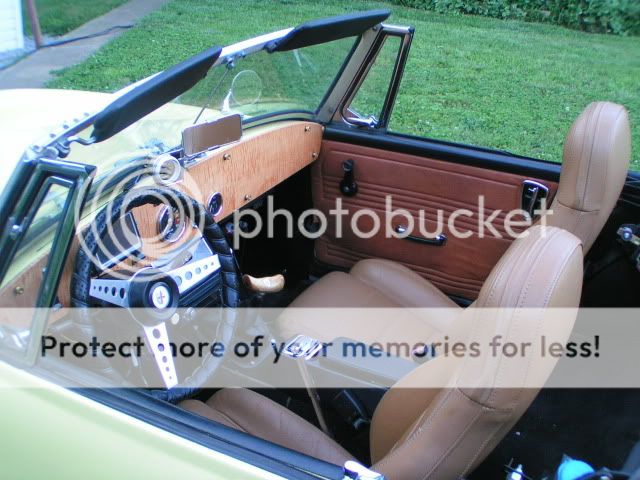
My wife wants a wood dash, but I am not really a supporter. Seems to me the dash finish is gonna age quickly since of tempature changes, sunlight, moisture, etc...
 
Polyurethane finish or something similar and no worries on the wood, even so I put the tonneau on whenever I park for more than a minute or two, for more reasons then just sun fade, but that's one of 'em. The wood is very pretty but the dash will be thicker; the gauge brackets will have to have their "legs" shortened, the lighting set up will need to be modified. The top and bottom cowling must be "dealt with" somehow. I doubt it's less work in the end but it's "different". I'll probably be ditching mine this winter just because I'm slowly taking everything back to more original (looking). Pretty soon mine should look for all the world like it did when it first left the dealer, at least from a distance and to the not-too-overly-educated!
 
I made a "wood dash" with a piece of veneer, that I did not even glue to the dash! The switches and instrument bezels hold it in place (so it is quite easy to go back to original!) I finished it with marine Spar Varnish, which held up fairly well, but is now in need of attention. I am going to re-do it with a product called Bristol Finish (available at marine stores) which is a two-part polyurathane that, from what I have seen on yachts, holds up VERY nicely (If you lay the surface flat, you can pour it on for a nice thick, glossy finish!).
 
Mine is a 1" thick slab of oak. My big hang up on redoing the original is I don't know what to do about the top and bottom cowling pieces. I have a bottom one.
 
Back
Top