-
 Hey Guest!
British Car Forum has been supporting enthusiasts for over 25 years by providing a great place to share our love for British cars. You can support our efforts by upgrading your membership for less than the dues of most car clubs. There are some perks with a member upgrade!**Upgrade Now**
(PS: Upgraded members don't see this banner, nor will you see the Google ads that appear on the site.)

Tips
- We have a special forum called "Member Articles" where you can submit actual articles for consideration for publication. Learn More
- Don't have an Avatar? If not, your avatar will default to the 1st character in your username. Go into "Account Details" to change your Avatar.
- Some basic forum navigation info: click
 Hey - did you know if you click on the title of a thread it will take you to the first unread post since you last visited that thread?
- Hey Guest - Is your British Car Club in our Clubs database? If not, send me a PM - Basil

- Looking for a local club? Click the "Clubs" tab above and browse hundreds of clubs world-wide.
- Add Android or iPhone APP: click
- Did you know - any picture or video you add in your posts in any marque-specific forum will also get added to the Media Gallery automatically.
- A few more tips about posting and replying: click
- Hey there Guest - be sure to keep your profile page up to date with interesting info about yourself: learn more
- More tips and tricks on Posting and Replying: click
 but were afraid to ask:
  STOP!! Never post your email address in open forums. Bots can "harvest" your email! If you must share your email use a Private Message or use the
  smilie in place of the real @
- Want to mention another member in a post & get their attention? WATCH THIS

- So, you created a "Group" here at BCF and would like to invite other members to join? Watch this!
- Hey Guest - A post a day keeps Basil from visiting you in the small hours and putting a bat up your nightdress!
- Hey Guest - do you know of an upcoming British car event?
 Pretty Please - add it to our Events forum(s) and add to the calendar! >> Here's How <<
- Hey Guest - you be stylin' Change the look and feel of the forum to fit your taste. Check it out
- If you run across an inappropriate post, for example a post that breaks our rules or looks like it might be spam, you can report the post to the moderators: Learn More
- If you would like to try some different "looks" or styles for the site, scroll to the very bottom, on the left and click the Style Selector.
You are using an out of date browser. It may not display this or other websites correctly.
You should upgrade or use an alternative browser.
You should upgrade or use an alternative browser.
TR2/3/3A Brake Lamp
- Thread starter Got_All_4
- Start date


charleyf
Luke Skywalker

Offline
If you are willing to find some way to put pressure into the intake of the switch ( air compressor) and see if you can get continuity across the terminals with an ohm meter.
I doubt that you would affect the pressure in the line much at all by removing a switch and immediately replacing it.
I doubt that you would affect the pressure in the line much at all by removing a switch and immediately replacing it.

Geo Hahn
Yoda
Offline
I agree, I have always been able to swap the switches w/o having to bleed the system.
Does anyone know... are the threads on these the same as on a VW pressure switch? I ask as there is a German-made version I am using on my VW that seems very durable. Costs a bit more but I think this is a place where a few more bucks are worth it.
Does anyone know... are the threads on these the same as on a VW pressure switch? I ask as there is a German-made version I am using on my VW that seems very durable. Costs a bit more but I think this is a place where a few more bucks are worth it.

TR3driver
Great Pumpkin - R.I.P
Offline
Usually I get fluid running out rather than air going in, but it might depend on whether you have the residual pressure valve or not. To reduce the amount of fluid lost, I use a bar to hold the brake pedal slightly depressed.
IIRC the threads are at least compatible with NPT. I once used a switch from an old Ford pickup and it fit the threads.
Later I got frustrated with frequent failures, and mounted a mechanical switch on the pedal box.
Then the most recent time around, I built a simple bracket to mount the switch inside above the brake pedal.

IIRC the threads are at least compatible with NPT. I once used a switch from an old Ford pickup and it fit the threads.
Later I got frustrated with frequent failures, and mounted a mechanical switch on the pedal box.
Then the most recent time around, I built a simple bracket to mount the switch inside above the brake pedal.
Geo Hahn
Yoda
Offline
Yes I am using DOT5. Why do u ask?...
There has been discussion linking DOT 5 with premature switch failure.
https://www.britishcarforum.com/bcf...ot-5-brake-switch&highlight=brake+switch+moss
Half way down that thread I mention:
That's what they seem to be saying. I'll be in the test group on this one as I have DOT5 and the switch sold by Moss -- Intermotor brand p/n 51620, made in England.
Switch installed 9/9/2009, 87,853 miles. Now at 92,997. So far, so good.
I has now been 9 years and 15,000 miles and the switch is still okay. I do have a relay on that circuit which may help preserve the switch.


Offline
Ron Francis Wiring has a low pressure, Dot5 compatible switch. I use one on a '55 Ford F100 converted to front disc brakes and using Dot5. Pricey compared to regular switches.
https://www.ronfrancis.com/prodinfo.asp?number=SW-32
https://www.ronfrancis.com/prodinfo.asp?number=SW-32
TR3driver
Great Pumpkin - R.I.P
Offline
I wonder what makes the original switch not compatible with DOT5.
On the one I cut apart, it appeared that the diaphragm was a metal on metal seal with no O-ring or similar, and enough Dot 5 had crept through the joint to foul the contacts.
I don't know if DOT 3/4 doesn't creep as well (although I suspect that us the case), or if it doesn't foul contacts like DOT5 does.
Supposedly, there is also a Harley-Davidson switch that will fit and stand up to DOT5. But I haven't looked into that myself.

CJD
Yoda
Offline
I wonder what makes the original switch not compatible with DOT5.
I think it is. However, much like when you change your engine oil to synthetic...if you have a bad seal the DOT5 will compound it.
My 63 year old TR2 switch is still ticking along on DOT 5 for 1-1/2 years and counting. My TR3 lost it’s switch immediately on the change to DOT5, but went fine for 6 years afterward.
OP

Got_All_4
Luke Skywalker
Offline
It's probably been 6 years for mine. The problem could have been there longer and just didn't notice. I was backing into the garage at night with a big white box behind me and that's when I noticed there was no reflection. So the molecules are smaller in DOT 5?
TR3driver
Great Pumpkin - R.I.P
Offline
Seems to be a lot more complicated than that.
Eg, https://www.sciencedirect.com/science/article/abs/pii/0043164876902374
Eg, https://www.sciencedirect.com/science/article/abs/pii/0043164876902374
I did not read the original article, but, if I am wildly optimistic, having a switch that has never seen DOT 3/4 might be a solution , easier than distilling something to get rid of impurities. I guess this shows there is a scientific background to our practical difficulties, but no real solution except to try it! I shall try, and frequently back up to a white object to make sure the lights work!. I shall also use LEDs
On to the next "problem"
thank you
On to the next "problem"
thank you
TR3driver
Great Pumpkin - R.I.P
Offline
FWIW, I have seen rapid failures with new switches that were never exposed to DOT 3/4 (unless the manufacturer did it).
Silicone oil does have a tendency to find it's way through gaps that other things won't go through; and spreads to cover the surface even when it has to oppose the force of gravity to do so. It will actually climb uphill! There has been some debate as to just how it does that; as shown by the article summary I referenced above.
Silicone oil does have a tendency to find it's way through gaps that other things won't go through; and spreads to cover the surface even when it has to oppose the force of gravity to do so. It will actually climb uphill! There has been some debate as to just how it does that; as shown by the article summary I referenced above.
OP
Got_All_4
Luke Skywalker
Offline
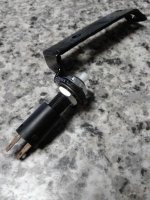
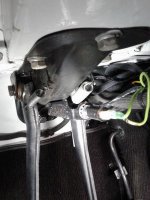
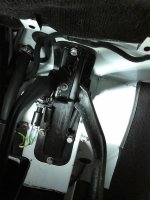
The next time I went out for a ride the brake light did not work no matter how hard I pushed the pedal. Couple days later I puled the car into the working garage and it work as it is suppose to. Go figure. Anyway not trusting it so went to Summit Racing and bought a universal brake switch. Brain stormed it for a while and it turned out a lot like Randles. Works perfect.