

-
 Hey Guest!
British Car Forum has been supporting enthusiasts for over 25 years by providing a great place to share our love for British cars. You can support our efforts by upgrading your membership for less than the dues of most car clubs. There are some perks with a member upgrade!**Upgrade Now**
(PS: Upgraded members don't see this banner, nor will you see the Google ads that appear on the site.)
You are using an out of date browser. It may not display this or other websites correctly.
You should upgrade or use an alternative browser.
You should upgrade or use an alternative browser.
Brake Drum Concentricity
- Thread starter Geo Hahn
- Start date

Moseso
Jedi Knight
Offline
That might work, or it might introduce enough wiggliness that it won't. Never tried it.Geo Hahn said:Por exemplo. can you mount it backwards on a hub and use a dial indicator to check it?
I've done this: Adjust the shoes one notch tighter than you would want them on the road. If you notice some difference as you rotate the drum, that's "normal" -- they're never perfect. If it binds up hard enough that you can't rotate the drum by hand past the shoes, but it's OK when the "high spot" is between the shoes, it's time for turning, or a new drum. It doesn't quantify your problem in thousandths of an inch, but it's a reasonable go/no-go test.


angelfj1
Yoda
Offline
George: Try this. it may give you a rough idea.
you will need some graph paper, a good pencil and a decent compass preferably from a drafting set, and a drawing triangle or small square.
remove drum and place down onto a sheet of 1/4-inch graph paper or similar.
Using a sharp #2 pencil trace the outline of the drum , that is the outside circumference onto the paper.
Go inside, pour a cool one and proceed. We will use some geometric construction to find the center of the circle which represents the brake drum.
see sketch below
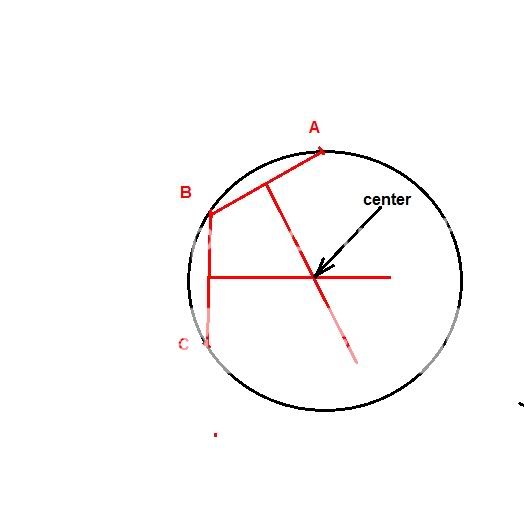
Adjust the compass to a radius a little greater than what you have. In this case 6 inches should work.
At a point on the circle, say at 12 o'clock, we will cal this point 'A' place the pivot of the compass and draw an arc which intersects the circle at point 'B'.
Without changing the compass, place the pivot on point 'B', and draw an arc which intersects the circle at point 'C'.
Now, carefully draw a straight line and connect 'A' to 'B' and 'B' to C.
Measure line AB and BC. They should be equal or very close.
Find the center of these lines (AB and BC) and draw a perpendicular line from the center to a point beyond where you suspect the center of the circle should be located.
The point where these two perpendicular lines intersect is the center of the circle which represents your brake drum.
Mark the center point. Now with the pivot of the compass on the center, adjust it to touch the circumference at any point on the circle. Draw a circle using the compass. If the circle is true (if the drum is round), this circle should coincide with the outline of the brake drum.
The amount of disagreement is equal to the "out of round" of the brake drum.
Good luck
Frank
you will need some graph paper, a good pencil and a decent compass preferably from a drafting set, and a drawing triangle or small square.
remove drum and place down onto a sheet of 1/4-inch graph paper or similar.
Using a sharp #2 pencil trace the outline of the drum , that is the outside circumference onto the paper.
Go inside, pour a cool one and proceed. We will use some geometric construction to find the center of the circle which represents the brake drum.
see sketch below
Adjust the compass to a radius a little greater than what you have. In this case 6 inches should work.
At a point on the circle, say at 12 o'clock, we will cal this point 'A' place the pivot of the compass and draw an arc which intersects the circle at point 'B'.
Without changing the compass, place the pivot on point 'B', and draw an arc which intersects the circle at point 'C'.
Now, carefully draw a straight line and connect 'A' to 'B' and 'B' to C.
Measure line AB and BC. They should be equal or very close.
Find the center of these lines (AB and BC) and draw a perpendicular line from the center to a point beyond where you suspect the center of the circle should be located.
The point where these two perpendicular lines intersect is the center of the circle which represents your brake drum.
Mark the center point. Now with the pivot of the compass on the center, adjust it to touch the circumference at any point on the circle. Draw a circle using the compass. If the circle is true (if the drum is round), this circle should coincide with the outline of the brake drum.
The amount of disagreement is equal to the "out of round" of the brake drum.
Good luck
Frank

Bremer
Jedi Hopeful
Offline
Frank, that is a very scientific way of determining the centre of the outside diameter of the drum. I respect the approach, however, it is the inside of the drum that we are normally concerned with. I'm not sure that we can assume that the wall thickness is the same all the way around.
I don't see an easy way to determine out-of-round. A better brake shop should be able to surface grind the drums and arc grind the shoes to match.
I don't see an easy way to determine out-of-round. A better brake shop should be able to surface grind the drums and arc grind the shoes to match.
angelfj1
Yoda
Offline
Bremer said:Frank, that is a very scientific way of determining the centre of the outside diameter of the drum. I respect the approach, however, it is the inside of the drum that we are normally concerned with. I'm not sure that we can assume that the wall thickness is the same all the way around.
I don't see an easy way to determine out-of-round. A better brake shop should be able to surface grind the drums and arc grind the shoes to match.
OK I understand now. But if the outside is confirmed as 'round', couldn't you use calipers or a micrometer and measure the thickness? For the inside to be 'round', the thickness would have to be uniform so that the inside and outside circles are concentric.
Wouldn't that be a valid test?
OP

Geo Hahn
Yoda
Offline
The outside is kinda rough so a measurement of thickness may be inconclusive.
In any case, I just remembered I have a spare half-axle lying around -- I can mount the drum to that and see if I have room to get a dial indicator on the inside surface.
Only thing is it has a hub puller mounted to it with about 400# of torque in a futile effort to pull the hub. Took it to a friend's house (Healey owner) to get that torque, will probably have to visit him again to set it free.
What's behind all this is a 'whump-whump' I was getting from the one of the rear brakes. Could be a couple of things. I'm getting new shoes but seemed prudent to verify that the drums are roundish.
In any case, I just remembered I have a spare half-axle lying around -- I can mount the drum to that and see if I have room to get a dial indicator on the inside surface.
Only thing is it has a hub puller mounted to it with about 400# of torque in a futile effort to pull the hub. Took it to a friend's house (Healey owner) to get that torque, will probably have to visit him again to set it free.
What's behind all this is a 'whump-whump' I was getting from the one of the rear brakes. Could be a couple of things. I'm getting new shoes but seemed prudent to verify that the drums are roundish.

TR3driver
Great Pumpkin - R.I.P
Offline
+1 for Moses' approach. If you can turn the drum a full turn by hand, but there is some drag all the way, then it's very close to perfect. Certainly not bad enough to cause 'whump-whump'.
Of course the drum locates to the hub, so the problem could be a bent hub, axle etc, not necessarily the drum itself.
Of course the drum locates to the hub, so the problem could be a bent hub, axle etc, not necessarily the drum itself.
G
Guest
Guest
Guest
Offline
I have been working on these cars for 40 years. Take the drum to a garage with a brake lathe. Chuck it up using a tapered centering cone and do a light cut on it. Slip the guy a fin or a six pack. Might not be up to space shuttle specs,but on a LBC it works pretty well.Remember the KISS principle and if you think of working on big lawn mowers,it makes things a lot simpler.
Lewis_McDorman
Senior Member
Offline
This sounds like an opportunity to buy some awesome new precision measuring tools. That's how I've built my tool collection--if I do the work myself, I spend the money I save on any tools needed to do the job.
Lewis_McDorman said:This sounds like an opportunity to buy some awesome new precision measuring tools. That's how I've built my tool collection--if I do the work myself, I spend the money I save on any tools needed to do the job.
There you go. BTW - the same principle can be applied to buying more cars too.


Don Elliott
Obi Wan
Offline
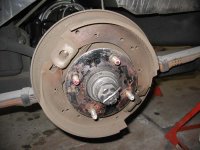
In both cases where I was restoring TR3As, I took the original shoes to a brake and clutch shop to have them put new linings on the base shoes. They told me to bring in the drums. I told them that the drums had just been turned. He insisted because he had tooling or some talented way to match the new shoes to the interior of the rear drums. They worked out fine. On mine, I've used these same rear 10" linings in these drums for the past 20 summers having driven 104,000 miles with them and with no issues.
This is from my 10" assembly taken about 10 years ago.
This is from my 10" assembly taken about 10 years ago.
Attachments

tomshobby
Yoda
Offline
Don Elliott said:In both cases where I was restoring TR3As, I took the original shoes to a brake and clutch shop to have them put new linings on the base shoes. They told me to bring in the drums. I told them that the drums had just been turned. He insisted because he had tooling or some talented way to match the new shoes to the interior of the rear drums. They worked out fine. On mine, I've used these same rear 10" linings in these drums for the past 20 summers having driven 104,000 miles with them and with no issues.
This is from my 10" assembly taken about 10 years ago.
That is how all reputable shops did it when drum brakes were standard and linings were replaced rather than just buying new shoes.
trfourtune
Jedi Knight
Offline
be carful. I don't think triumph wheel "stuff" is hub centric, but is centered by the bolts, maybe that's just the wheels.
Rob
Rob