• Hey Guest!
    British Car Forum has been supporting enthusiasts for over 25 years by providing a great place to share our love for British cars. You can support our efforts by upgrading your membership for less than the dues of most car clubs. There are some perks with a member upgrade!

    **Upgrade Now**
    (PS: Upgraded members don't see this banner, nor will you see the Google ads that appear on the site.)
Tips
Tips

TR2/3/3A Bleeding Lockheed Master

mgedit

Jedi Knight
Country flag
Offline
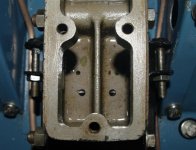
I was having some issues with my master leaking and have used some EPDM rubber to make new top and front gaskets. As with the first time I installed the master, once again having problems getting it to bleed. Attached is picture of inside of MC. I think the pistons are not fully returning (issue I had before). As I hope you can see from the picture, the piston is still blocking the large hole. There is at least 1/4 inch of movement before the rod contacts the piston, so there is slack in there suggesting the piston should move a little more (I've loosened off the front bolts to allow maximum pedal travel). MC worked fine earlier after I finally got it to bleed. Was thinking of using compressed air to force the piston back farther in the bore. Any other ideas? Guess most important question is whether the pistons look correct or are they too far "forward" at rest. Cheers, Mike

attachment.php
 

Attachments

  • Pistons in Master.jpg
    Pistons in Master.jpg
    58.1 KB · Views: 216
Are you using a vacuum bleeder or by hand? If the latter, it may help to bleed it at the pipe on the master to get things going. Tom
 
Can't tell what we are looking at...is the dark in the lower part of the holes rubber or open? If it's open, I think it's good. If it's the back side of the rubber cup, then it's not retracting enough.

Actually...it just came back to me. The tiny holes at the top are the ones that provide the fluid to the cylinder. The large ones just balance the back of the piston, but don't go to the pressure side.
 
Thanks guys. Away from home now helping son move. Hope to get back at this later in week. Tried both normal and vacuum bleeding on clutch. Neither one working. Was not sure if that tiny hole provided fluid on pressure side. Can't imagine much flow going through there for bleeding? Cheers, Mike
 
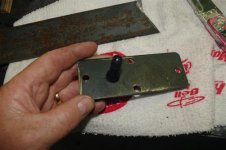
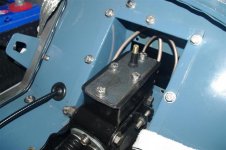
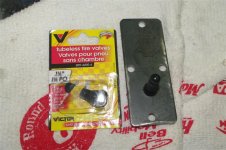
So after a couple of days of additional frustration trying to bleed the clutch by conventional method and also trying to use vacuum, I decided to go with pressure bleeding. BTW the brakes bled easily using method described in manual. Seems that the smaller pipe and perhaps the valve on the brake side are more effective for initial bleeding. In any case, made a simple flat steel plate and installed a tire valve. After installation of plate, 3 pumps with bicycle pump, open bleeder at slave, and air and fluid shot out into bleeder bottle. One more conventional bleed to make sure all OK and I was done. Total time to make plate maybe 30 minutes, cost about $3.00, bleed time less than 5 minutes, level of frustration zero. If anyone is about to bleed a Lockheed clutch, I'd suggest you not even bother with the other methods. Just make up this simple plate for pressure bleeding and be done with it. Some pictures attached for those who are interested. Cheers, Mike

attachment.php


attachment.php


attachment.php
 

Attachments

  • Plate with Valve.jpg
    Plate with Valve.jpg
    52.3 KB · Views: 177
  • In Car.jpg
    In Car.jpg
    48.8 KB · Views: 168
  • Parts.jpg
    Parts.jpg
    69.6 KB · Views: 167
Awesome Mike. Glad to hear that you got it solved.

Cheers
Tush
 
Back
Top