• Hey Guest!
    British Car Forum has been supporting enthusiasts for over 25 years by providing a great place to share our love for British cars. You can support our efforts by upgrading your membership for less than the dues of most car clubs. There are some perks with a member upgrade!

    **Upgrade Now**
    (PS: Upgraded members don't see this banner, nor will you see the Google ads that appear on the site.)
Tips
Tips

TR2/3/3A anyone know what this valve is and where it goes on a TR3a?

2billydavies

Senior Member
Offline
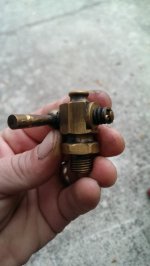
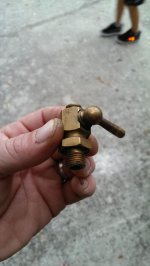
was going through a small box of parts, and came across this brass valve. I have no idea where it came from or where it goes on my TR3a. Anyone have any idea? Thanks!

IMAG0426.jpgIMAG0427.jpg
 
There is a spring inside the tap which keeps pressure on the taper fitting and is supposed to make it not leak. Most of the time, that is true.
Jerry
 
The spring is on the outside, and visible in the photo.

What I can't tell is whether the threads are tapered or not. If they are tapered (pipe threads), then it might be the radiator drain tap instead of the block drain tap.
 
thanks guys.... definitely not the radiator plug. completely different size and design. i'm going to check out the area around the oil filter. i have no clue where it came from other then on this car somewhere. thanks for the ideas/starting points!
 
Looks like KLeykamp was right.... fits right above the starter motor.
Here's my next question. Actually 2.

I have another one of these things in my "parts" box. Thanks to Kleykamp, I found the first one above the starter motor. Is there another spot to screw in the second one?? Or is this other one I have a spare that I picked up along the way? They are EXACTLY alike.

Last question: what the heck is this thing for? Does it just drain the water out of the main part of the engine??

Thanks everyone... I"m almost at the point of turning the key....
 
It's a spare then - only one on the block. But the original radiator plug did look nearly the same originally as Randall mentioned earlier - so it may go on the radiator if it had been pulled for a modern style plug.

The block drain does what what you think - drains the main part of the engine, if you are lucky that is - quite often the back part of the block gets plugged up with sludge so its good to flush out from that drain from time to time.
 
well, looks like you were right. the spare one i had does go into the bottom of the radiator. looks like my father may have replaced it years ago with a screw-type valve rather than the spare i have. thanks a ton... huge help!
 
They're easy enough to fix, though. Remove the cotter pin, spring and washers from the bottom, paying attention to which way the movement limiting washer goes. Remove the tapered core and paint it with a fine abrasive (ISTR I used rubbing compound or maybe jeweler's rouge), then put it back into the body and turn back and forth, lifting occasionally to distribute the abrasive. A lot like grinding valves (which is basically what you are doing). After the abrasive turns dark, disassemble, clean and inspect. Once it's shiny all around, you're done. Give it a coat of silicone grease and put it back together, making sure there is good tension from the spring "as installed". I had to replace the springs, by cutting lengths from a hardware store spring, with a Dremel & cutoff blade. I also replaced the flat washers, with stock 10-32 washers IIRC; and of course the cotter pins.
 
The block drain does what what you think - drains the main part of the engine, if you are lucky that is - quite often the back part of the block gets plugged up with sludge so its good to flush out from that drain from time to time.[/QUOTE]

If you back flush from the block drain, do you have to be careful about pressure?
or can you just rig up a garden hose connection & turn it on?
 
I would be wary about city water pressure if the heater core is still in the loop. If you are just working with the block then I'd say have at it.

You can sometimes remove the valve and work a length of wire or bamboo skewer or what have you in there to loosen up sediment - though a more effective clean out (short of removing the liners) was a lipo-suction using a length of small brass tubing and a shop-vac with the head off and the tubing inserted into the various openings into the coolant jacket.
 
Back
Top