
• Hey Guest!
    British Car Forum has been supporting enthusiasts for over 25 years by providing a great place to share our love for British cars. You can support our efforts by upgrading your membership for less than the dues of most car clubs. There are some perks with a member upgrade!

    **Upgrade Now**
    (PS: Upgraded members don't see this banner, nor will you see the Google ads that appear on the site.)
Tips
Tips

TR2/3/3A Another wheel bearing thread

TexasKnucklehead

Jedi Knight
Country flag
Offline
This morning at breakfast I got to see the TR4 workshop manual including the picture of a dial indicator but no explanation or indication of what the bearing end-float should be. It seems in reading elsewhere, there should be no pre-load, and the end-float should be between at least .001, to .004 or .005 depending on who is defining it. Since we had no other dead horses to beat we decided to do a little math...

The threads on the end of the shaft and nut are 20 threads per inch. The castellated nut has six sides or flats, each with a slot to fit the cotter pin. The axle end has two holes drilled at 90 degrees to each other. This allows the nut to have 12 different positions per revolution to insert the pin, since each 1/2 flat exposes a hole.

1/20/12=.004 It seems very possible to get the end-float pretty close. Even with the seal not installed, I guess this measurement must be done prior to grease added, or the measurement could be way off. It seems to me that either method of setting the float will result in the same setting.

We have a club member who has put over 100,000 miles on his TR3 and works on many TRs. He has never used nor heard of anyone using a dial indicator to set end float. Then again, he never replaced a stub axle or had a bearing fail like mine has. Maybe some of us are luckier than others -and after looking at my D-washer and inner race, he thinks I am the lucky one. Maybe you've got to be very lucky to drive a TR3 until a wheel falls off.
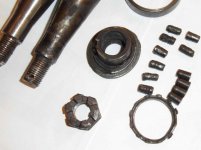
 

Attachments

  • deadhorse.jpg
    deadhorse.jpg
    50.2 KB · Views: 145
I've not personally had a wheel bearing failure that had grease in the remains. Of course you could argue that a bad bearing heated the grease and it burned away causing the failure and I guess that's plausible.
Like your club member I'm one of the lucky ones, I guess. I do have a dial indicator but have not bothered to use it on front wheel bearings. Perhaps not too late to start.
Tom
 
In the AF I investigated incidents/accidents. I was called to one T-38 incident when an engine had thrown it's turbine blades shortly after takeoff. We decided what happened is that the accessory bearing had failed, eventually becoming red hot as it disintegrated. The heat eventually lit off the oil internally in the engine, and that hot exhaust vented through the center of the turbine disc. The extra heat caused the turbine to fail and sling out of the plane, cutting through cables, hydraulics, and frames as it went!

The military does regular SOAP (spectorgraphic oil analysis program) samples every 100 hours on aircraft engine oil for every airplane. When I reviewed the SOAP history, the bearing had left excessive metal in the oil for almost 250 hours before it disintegrated. Unfortunately, it's hard to make a teenage Air Force Airman pay attention to his job sometimes. The excessive metal went unnoticed until the engine blew...but the warning had been there.

Since that investigation, I have reached a point where I can "feel" engine bearings that are on their last leg. It's all in the abnormal, low pitched, rumble. Every time I felt it, I checked and the SOAP's were under observation. Frequently the plane was placed under 10 hour SOAP tests to track the abnormal metal.
 
Back in the 50s and 60s I worked on quite a few non British cars and the nuts on the spindles were tightened up until snug, spun the wheel and snugged up the nut again, then backed it off until the next split pin hole lined up and that's where it stayed. Never had a bearing failure in all those years. Of course these were all tapered bearings. The ball bearings in some of our cars are a different story, as the center race must be held in a position so no side load is present in the bearing, reason for the spacers and shims, plus factory torquing specs should be adhered to. On a ball bearing, those who don't use the proper spacers and shims are asking for problems down the road, literally. Ball bearings are only designed for minimal temporary side loading, as in cornering. PJ
 
Back in the late 60's through late 70's, one US brand recommended (and we were taught at the dealership..and I still do it) to use a BIG Crescent wrench, spin the hub/rotor in direction of tightening, and tighten is almost as hard as you can with a 14-15" Crescent. This makes absolutely certain the races are seated in the hubs, and any stray grease is pressed out of between races and rollers.
Then back off 1/2 turn or so...then put your pinkie in the hole in the end of the wrench, and pull it down tight until it stops. Set the stamped steel castellated piece onto the nut, and pin it.
Never had a failure, and I've done thousands and thousands.

I have a big problem with that in my background setting up for "end float"..even my Jag has "end float".
But, if I have an issue and cannot get it better than too tight or too loose, I swap the nuts left and right.

They are never exactly the same start point for the threads compared to the key slot.
 
What DOC said, I was taught the same thing. I have never put the miles on a tr3 at one time like you do TexN and driven through those deserts, to me that means a lot. Hard to say what went wrong, my first guess is somehow the bearing got dry and you know the rest. I will say, I will check my bearing out before I drive to Idaho or something, because I usually never think about them after I have done the grease them up tighten them up hard and tight and back off that fuss. Anyways keep on trucken and doing your runs they are cool and I will/might try it myself someday.
Peace out Steve
 
Back
Top