• Hey Guest!
    British Car Forum has been supporting enthusiasts for over 25 years by providing a great place to share our love for British cars. You can support our efforts by upgrading your membership for less than the dues of most car clubs. There are some perks with a member upgrade!

    **Upgrade Now**
    (PS: Upgraded members don't see this banner, nor will you see the Google ads that appear on the site.)
Tips
Tips

Another panel inplace

TR6oldtimer

Darth Vader
Country flag
Offline
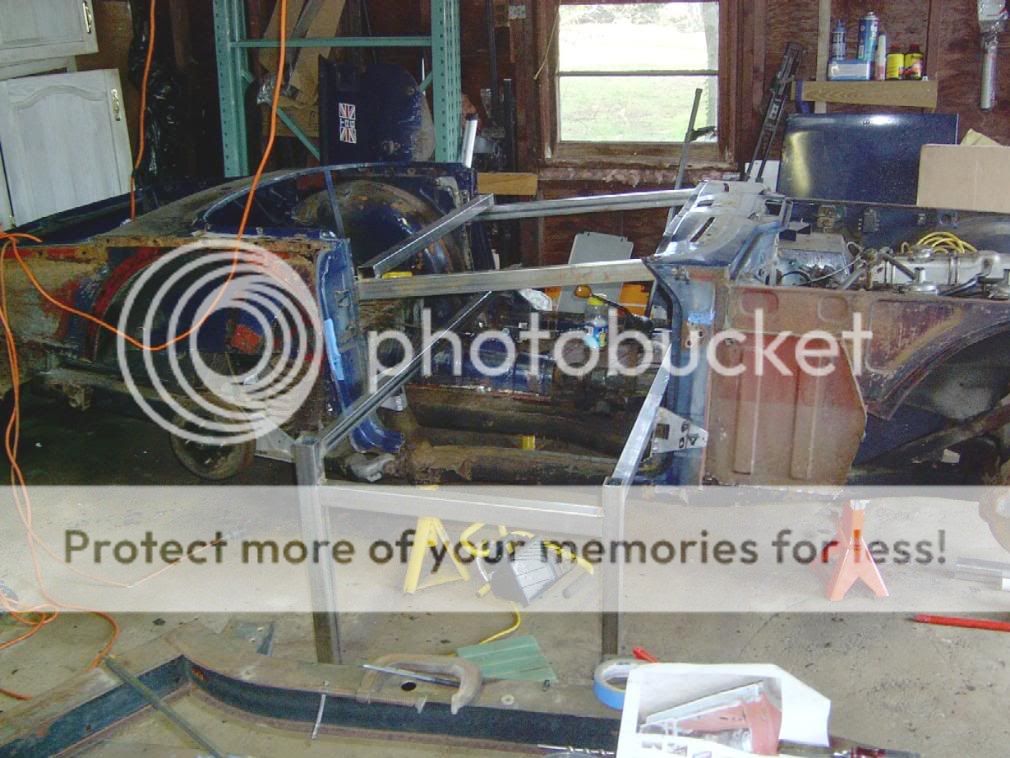
One step closer, I can begin to see an end...

 
Looks good, Ray. Are those brazes, and if so, are you going to finish the seams with welds. The original, as you know, was spot welded and brazed.
 
<span style="font-weight: bold">Boy that looks awfully familiar, great job.</span>
IM000173.jpg
 
Looking good Ray.
I wish I had the skills to do something like that.
 
Bill, yes the floor panel was plug and stitch brazed in with the plugs matching the original spot weld locations. In this application a brazed joint or plug is as strong or stronger then a spot or MIG plug weld. The reason is the bronze will weep between the two pieces of metal binding it to a larger area then a weld will.

When I started this project I got all excited about the new goodies I could buy. A TIG was not in the budget, a good MIG was attainable, and a spot welder would have been neat. Then I looked around. In my tool inventory was a sputter box and oxy/acet torches and the such. I knew how to gas weld and braze. So, rather then buy additional equipment, which I would have had to learn how to use, I decided to go with what I had.

The first floor I put in I stitched gas welded and brazed. When I did the rockers, after researching and discussing with professional welders, I went with the brazing and have been a happy camper. Goes fast with little warping. The only extra work is getting the flux off the weld. But then I do not have to grind.

Oh, and before I opted to braze I did a destructive test on a plug weld, a spot weld, and a brazed plug weld. To my surprise, the brazed plug weld was the hardest to pull apart.

Oh, the only down side to brazing is the flame. Care does need to be taken not to scorch your body or burn down the shop.

I also have used the oxy/acet for panel body work, bumper repair, and many more things.

So, while brazing may not be for everyone, but it works well for me.

I do envy you and your plasma cutter....
 
Thanks for the first hand regarding brazing. I may get an oxy acetylene rig for my own use instead of a mig. Every one I know has poh pohed brazing, but then they're all welders or wanna be's. I wish I had read your post before I repaired the floor in my J-H. But, it worked out all right anyway.
 
Ray - Very Nice!!

Like Tom, I'm in a similar boat... Hopefully, in a month (or year or ...), I can post similar pictures!!

In the meantime, keep up the excellent work - and I really appreciate seeing all the photos. Thank you!!
 
What do you use to clean up the hardened flux after a braze? It leaves a hard black residue that is really tough. Also - what kind of rods to you prefer - the kind with the flux coating or do you like to apply the paste flux by hand and go with a bare rod? And what size/composition rods? We just got an oxy/acet unit and would like to become better brazers.
 
CraigLandrum said:
What do you use to clean up the hardened flux after a braze? It leaves a hard black residue that is really tough. Also - what kind of rods to you prefer - the kind with the flux coating or do you like to apply the paste flux by hand and go with a bare rod? And what size/composition rods? We just got an oxy/acet unit and would like to become better brazers.

For brazing sheet metal, I use the LFBB 1/16 inch bare rod and a 1 or 0 tip on the torch.

Given I am not attempting to sweat in the entire sheet metal joint, I opted not to use a paste flux. In stead I use Peterson No 1 blue flux. This stuff is granulated, so I poked a hole in the top of the can and hot rod, the dipping of a warmed rod into the powder. I prefer the bare rod because I can control the amount of flux needed.

Most of the residual flux comes off by using an angle grinder and a course cup wire brush. In places I cannot get to, I use a modified, old body hammer with a sharp point and knock off the flux much the same way you would the flux residue from arc welding

You need a slightly oxidizing flame, and do not overheat the base metal more then needed to melt the rod and sweat the joint.

Practice and patience is the name of the game and watch that flame, it extends and remains hot much further then you can see.

Perhaps Kerry, Aweman will chime in and help both of us out.
 
Back
Top