• Hi Guest!
    If you appreciate British Car Forum and our 25 years of supporting British car enthusiasts with technical and anicdotal information, collected from our thousands of great members, please support us with a low-cost subscription. You can become a supporting member for less than the dues of most car clubs.

    There are some perks with a member upgrade!
    **Upgrade Now**
    (PS: Subscribers don't see this gawd-aweful banner
Tips
Tips

AH crankshaft seal...

Johnny

Darth Vader
Country flag
Offline
Just installed a Moss crank seal kit in my BJ7. Didn't have any problems installing it other than getting that little springy thing around the rubber seal, but I finally did get it installed. Now I have to remove some of the backing plate material in order to get it to fit. This is not easy as the backing plate is what about 3/8" thick? It's also very heavy. How did others do this?
 
I have a milling machine and did a rough cut to within 1/32" of the pattern. Then I did the final cut with a die grinder. The milling machine did most of the work. So far the seal has worked great! Have a good day!

John
 
Hello Johnny,
actually I bought the AH-Kit but I have not install that.
According the short description you have to remove the backing plate.Additional you get shape curve where you have to modify the backing plate. This are the general basics.
I also think about, how I will remove the material....
The best is, you know a machine shop. But I understand you would like to do it by your own...
Some suggestions: drilling holes and remove the rest with a angle grinder ( flex). After that you can grind it with a mill machine. Or you have a chance with a plasma cutter (I don`know the influence of the heat)

Another suggestion, I think about corossion, because my Kit is natural aluminium ,without surface treatment. Do you paint your Kit ?

Bye Michel- who would like to do it by the hole method
 
Johnny said:
Just installed a Moss crank seal kit in my BJ7. Didn't have any problems installing it other than getting that little springy thing around the rubber seal, but I finally did get it installed. Now I have to remove some of the backing plate material in order to get it to fit. This is not easy as the backing plate is what about 3/8" thick? It's also very heavy. How did others do this?
Sounds like the same seal kit I bought from BCS. I believe BCS has an exchange service for your rear engine plate or your could send them your plate and have them do it. I had Blades Design do mine because it was conveinient because of his location(north Texas). The spingy thing was the hardest part for me but only took 15 minutes when I used a L-shaped pick type of tool that I bought at Harbor few a few dollars.
Patrick
 
I used a sawzall with a bi-metal blade to cut 3/8" metal. It worked well except it was difficult to get the bottom cut right. The side cuts were easy. Mine was the BCS kit with the flat bottom bracket, not a round one. I cut mine a little too deep. I should have cut it higher up and used a grinder to finish the bottom edge.

IMG_0764-1.jpg
 
Hello johnny,

I used a 4" angle grinder and a file. Ground it to the line I marked then cleaned up and removed burrs with the file. I had also made the housing myself but that's because I can,

Hello germanmichel,

I don't think you will have any problems with corrosion as there is still a certain amount of oil mist and heat in that area.

For corrosion to occur you will need moisture and I think if you get any in there you will have other issues to deal with.

Most of the aftermarket seal housings come anodised and that should be another reason not to worry about corrosion.

If you are still concerned then paint it.

Best regards,

bundyrum.
 
Bundyrum, yeah, I did it just like you. Plain old fashion file and grind. Used two grinder stones, took about 3 hours. The shape of the seal housing is exactly the same as the rear crank (about 4 1/2") which made it easy to mark the backing plate. Would I do it again, I don't know, I can clean up a lot of oil drips for the time it took to install.

I had another club member tell me he purchased a "split seal" from Germany and with the thin metal used to hold the rubber seal didn't need to grind the backing plate. Anyone know of such a seal?
 
Mine came with a paper template which I took the a metal fabricator and for 25 bucks he used a plasma cutter. Fifteen minutes and it was done. I didn't have much trouble with the spring (so, that means it wasn't done right). This was several years ago and all it did was stop the leak there but the front end compensated for it and I still get drips. The gear box too cause I use Redline.
 
:yesnod: Finally finished it. Like I said, not sure it was worth all the effort but now it's done. I have to agree that this is only one area that leaks.
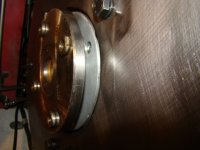
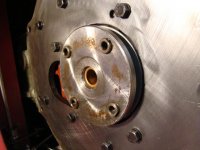
 

Attachments

  • 19468.jpg
    19468.jpg
    96.2 KB · Views: 306
  • 19469.jpg
    19469.jpg
    92.4 KB · Views: 308
Mine came with a paper template and I marked out the plate with about 3mm inside the cut line and jig sawed it out using pentty of oil as a lubricant, then a mixture if grinder and grinding wheels on a drill to finish.

Bob
 
I borrowed a friends plasma cutter but it was not powerful enough to cut 3/8 steel. I finally used a jigsaw and metal blades. Finished with 4 " grinder. I have done about 4 engines and decided that leaks in this area are from other than the seal around the crankshaft. Put a straight edge on the back plate and make sure it is flat. No burrs, no leftover paint to make it not seal. I also started using a gasket goo called "the right stuff" . It seems to work very well.

Put in a PVC valve between the valve cover and the carbs also. I think some of the occasional back pressure forces oil out the seal if you don't have one.

Jerry
BN4
BJ8
 
If anyone is interested, I have a new rear seal conversion kit from SC Austin Healey UK. Sells for $129 but I one saw one recently from a vendor on ebay, buy-it-now, for $99. I'll sell mine for $89. email me at rm@richardmayor.com
 
Hello Johnny,

The seal I used was the 2 piece Big Block Chevy one trimmed to fit.

Would I do it again? yes, absolutely without a doubt. Worth the time no matter how long it takes.

Apart from that there are always other work you get to do while it's torn down.

Best regards,

bundyrum.
 
Jerry said:
I borrowed a friends plasma cutter but it was not powerful enough to cut 3/8 steel. I finally used a jigsaw and metal blades. Finished with 4 " grinder. I have done about 4 engines and decided that leaks in this area are from other than the seal around the crankshaft. Put a straight edge on the back plate and make sure it is flat. No burrs, no leftover paint to make it not seal. I also started using a gasket goo called "the right stuff" . It seems to work very well.

Put in a PVC valve between the valve cover and the carbs also. I think some of the occasional back pressure forces oil out the seal if you don't have one.

Jerry
BN4
BJ8
Very good advise. I wish I knew that before I installed the crank seal. Which direction does the PVC valve go? Is there a way to install it so it doesn't show?
 
It will show no matter what, but I would guess that most of these cars had one installed during the late 60s and early 70s when they started the smog inspections. I guess that depends on the state rules. I put mine between the valve cover and the carbs. (although to be honest, I drilled and tapped a new port into the intake manifold for the hose from the valve cover). I was tired of seeing all the oil in the rear air cleaner.

I don't have the part number for the PVC. I found a plastic one, but I like the metal one that is talked about in the Nocks tech book.

Jerry
 
<span style="color: #009900">
Jerry said:
I don't have the part number for the PVC. I found a plastic one, but I like the metal one that is talked about in the Nocks tech book. Jerry
</span>

<span style="color: #FF0000">I have been reading all the references to a PVC. Correct me if I am wrong but isnt that poly vinyl choloride? I dont know of any reason to use it on my Healey. Maybe on some air lines in the shop. Would I be wrong to assume everyone is refering to PCV valve as in positive crankcase ventilation?</span>
 
fordtrucks4ever said:
<span style="color: #009900">
Jerry said:
I don't have the part number for the PVC. I found a plastic one, but I like the metal one that is talked about in the Nocks tech book. Jerry
</span>

<span style="color: #FF0000">I have been reading all the references to a PVC. Correct me if I am wrong but isnt that poly vinyl choloride? I dont know of any reason to use it on my Healey. Maybe on some air lines in the shop. Would I be wrong to assume everyone is refering to PCV valve as in positive crankcase ventilation?</span>
LOL!

I couldn't bring myself to correct them (we all know I have enough <span style="font-style: italic">issues</span> already), but I'm sure glad somebody did :wink:
 
Back
Top