• Hey Guest!
    British Car Forum has been supporting enthusiasts for over 25 years by providing a great place to share our love for British cars. You can support our efforts by upgrading your membership for less than the dues of most car clubs. There are some perks with a member upgrade!

    **Upgrade Now**
    (PS: Upgraded members don't see this banner, nor will you see the Google ads that appear on the site.)
Tips
Tips

About to paint - advice solicited

CraigLandrum

Jedi Hopeful
Offline
Our TR3A body is off the frame, everything removed, body and panels all blasted, dents pounded out, cheesed places patched with welded sheet metal, and small amounts of bondo applied to smooth out a few rough spots. Frame has been blasted, coated, and all new brake lines, brakes, fuel line, exhaust, handbrake cables, etc all done and ready for a painted body.

I bought a kit from www.paintforcars.com. Its the "British Racing Green Urethane Base coat Clear coat kit featuring 5 star Clear coat". To go along with that, I also bought a gallon of "MAXX Fill 2K High Build Urethane PrimerSurfacer w/ Activator Lt Grey" and for good measure I also bought a gallon of "5 Star Direct to Metal Self-Etching Primer w/Reducer". We have a 25CFM compressor that can provide up to 175 psi, two brand new Devilbliss gravity fed paint guns, a dessicant hose, plus mask and coveralls, mixing bowls, laquer thinner, acetone, etc.

My son blasted the panels and tub. We did not use soda, but used a relatively small/medium grit. Everything is down to the bare steel.

Now that you know the background, I would very much appreciate any advice from anyone that has done this themselves at home. Some of my questions are:

What did you use to wipe down/clean the metal before priming, and is it needed if I used the self-etching stuff? Is acetone or laquer thinner appropriate? Brake cleaner?

Would you recommend I use the 5-Star self-etching primer or the MAXX Fill 2K primer? The difference seems to be that the 5-Star forms a thinner 1-mil layer that *may* not need to be sanded before applying the basecoat, if this is done within 24 hours. The MAXX Fill claims to provide up to 2-mil coats.

Am I likely to need sanding regardless off the primer I use, or is it really practical to expect to be able to go right through the self-etching primer to color and clear within 24 hours as the primer can states?

If I have to use the MAXX Fill against the metal, the instructions indicate that I have to sand before applying color. Would I sand and go to color, or should a use the MAXX Fill, sand, put the 5-Star on top of the MAXX Fill, and then go immediately to color and clear?

If I have to sand, what do you recommend I take the sanding grit down to? 400? 600? 1500?

We are painting in a very large basement and have a long roll of thin clear plastic sheeting we were planning on putting up to protect walls, workbenches, etc. We were simply going to staple-gun it in wide strips to the basement floor joists, letting the strips hang to the floor. Has anyone done this? I've seen where some recommend misting down the plastic and the floor before painting. Is that really needed?

OK, I've asked a lot here. This will be our first attempt at painting a car ourselves and I feel fairly good that we have the right paint, the right tools, and the right area in which to work. Now we just need the benefit of your hard-earned wisdom to help us not screw up :smile:

Advice?
 
Urethane is going to require a forced air respirator. Forced fresh air respirator is recommended especially since you are painting in your basement. Urethane paints contain isocyanates which can't be filtered by a regular mask or respirator. Check it out please.
 
Roger that, Peter. Will be sure to use a fresh air respirator when spraying the Urethane.
 
Here are my quick thoughts...

You need to get a proper 'wax and grease remover' to clean the metal. I use PPG products so I use their DX330.

You need to use the etch primer on bare metal to get good adhesion. Unless your bodywork is PERFECT (I can almost guarantee it isn't - no one's is), you'll then need to spray some of the primer/filler and then block sand that down. Use a guide coat to see the low spots. I do initial block sanding with 220 wet but sand the final primer coat with 600 wet.

Repeat the primer/filler and block sanding as necessary to get the body as perfect as possible. 90% (maybe more) of a good paint job is the prep before the topcoat goes on. Spend the time with the filler, putty, primer and sanding to get a good base.

Then put on the topcoat.

There are a number of books that cover this and no doubt some sources on the 'net. Do some more research so you are really comfortable that you understand the process before you start.

Good luck.
 
..I never heard of where you got you paint, it doesn't matter. I never heard of your product either. Get a hold of them and tell them to provide a spec sheet for every product you bought.
Failing that go to your local auto body supplier and buy or order the DuPont or the PPG product book.DuPont also had a basic body/paint book. Then read it and cross reference what you have with their products to get an idea of what you are doing. You are not painting in the old sense, this new stuff is chemistry. If you mess it up you will have an expensive lesson learned.
 
First of all you can do this!
Second you really need to understand the whole paint system.
Your supplier is an invaluable resource. They should be able to answer correctly the questions about what to wipe down with and which primer to use. If they aren't friendly or can't find a new supplier.
Some of this stuff will kill you so really use the safety equipment, specially if you are in a basement. You really should have a venting system to move the air out of your temporary paint room. I did something similar in my garage. Hung plastic to form 3 walls. I use the garage door as the 4th wall. I raised it 6" or so and made a 1X2 frame that I stapled carboard to and placed a squirrel cage fan through it. This exhausted through a long tube make by using 6 mil plastic sheeting tape together with duct tape. The fan sat in the paint room sucking out the overspray and air. An open window across the garage and an opening at the top of the plastic walls let in new air.
The hi build primer and guide coats are where it's at. This is what will really make the final job look great. When I talked to a local painter (very expensive due to labor costs)he says he goes around the car 3 times doing the build primer and guide coats and sanding it down. FWIW!
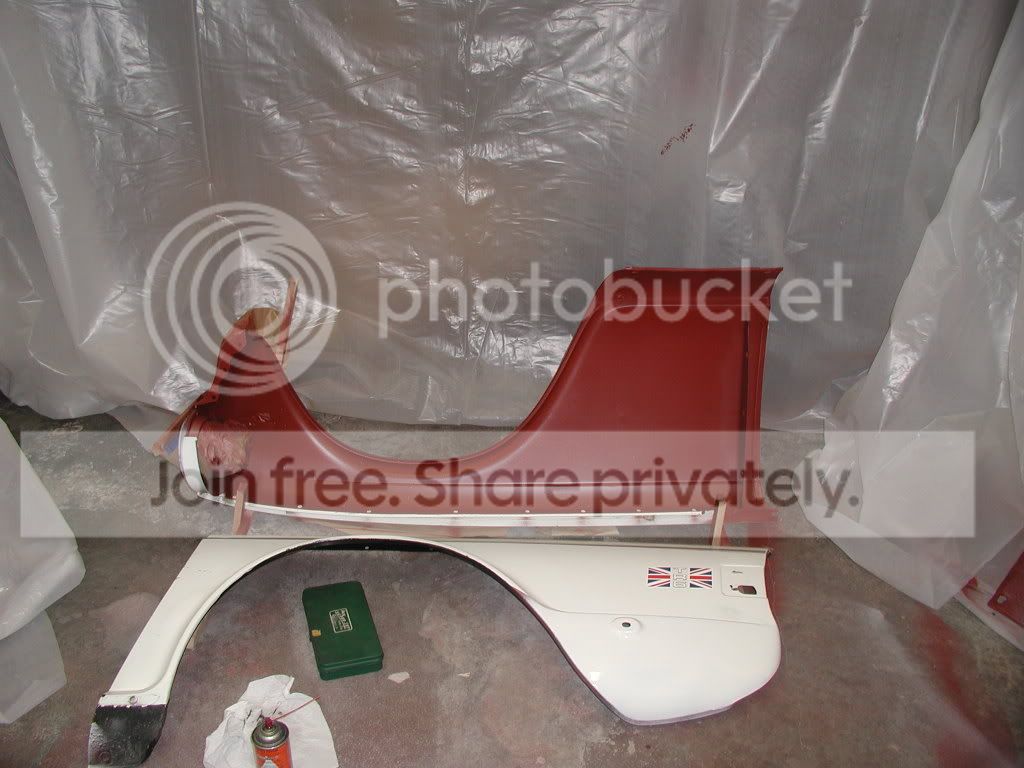
Here is photo of the fender after epoxy primer.
P1010006.jpg
 
I am not a professional painter, but have painted and will be painting my cars. This is what I have learned:

The metal surface should not be cleaned with lacquer thinner because it will flash off before you can wipe the contaminates away. It is best to use a cleaner like DX330 which is designed to lift the contaminants. Liberally apply then wipe off while still wet with clean rags, do not allow to dry. Also do not forget to blow out seams.

The next step is to apply the etch primer which is specifically designed for metal. You should avoid putting on a heavy coat because all you want to achieve is a coat that covers the metal and will take the filler primer. If the filler coat is applied within the 24 hour window, no scuffing is required, else scuff and apply the MAXX filler at least 3 mils. This is the coat you will use to fill scratches and minor imperfections in the body work, and with the guide coat sand to perfection. Hopefully your etch primer is a different color or shade then the filler so you will know if you have sanded the filler to much. The filler coat should be block sanded with 400 to remove high spots then 600 to remove the minor scratches.

If during this process you find very low spots, do not use the filler primer to raise it. Sand back to metal, use body filler, then start over.

Follow the instructions for the base and clear. Hopefully your base coat will go on nice and smooth without orange peel, otherwise it may need wet sanding with 600.

I would recommend you do the painting in pieces that are manageable rather then the whole car at once. Breaking the project down into manageable pieces will allow you time to give attention to detail that would not other wise be available.

Also, on use of plastic sheeting in the paint booth, keep in mind that any over spray that hits the sheeting will not adhere. So when you next use the booth, this stuff will come off and find it's way to your paint job.

I find painting to be one of the most rewarding parts of auto work, albeit a lot of work. Just keep in mind that this is a job that will be done only once and should not be rushed.

Good luck..
 
A nice little trick I learned for feeling high and low areas in your body work.
Use an old tshirt between your hand and the panel. It's amazing the difference over a bare hand.
I've also found that, being right handed, my left hand is much more sensitive to touch.
There is a lot to learn about body work and paint.
Don't be in a hurry. Do the best possible job you can, because it will probably be a one time thing and you will have to live with it. If you rush, you most likely will be disapponted with the results.
If you can feel it, you will see it after your shiny topcoat is applied.
 
I recently finished painting my Spitfire with BASF urethane. This is certainly something you can do.

One tip I can give is with respect to wax and grease remover and final wipe solvent. Apply these products using a spray bottle, not a rag. With a spray bottle you get more of the solvent onto to metal you are trying to clean, which means you use less, and you use less dirty rags as well.

I used 5 Star’s Xtreme 2K high build primer, which is also a bare metal surfacer, and was very happy with how easy the product was to use.
 
I like the tee shirt trick. One other thing I noticed about feeling for imperfections with your hand. If you run your fingers in the direction of the fingers (that is with your fingers parallel to the direction of travel) you will feel the imperfections much more then if you run your hand in the direction perpendicular to your fingers (that is running your hand in a driection accross your hand). Hard for me to describe with words.

I discouvered this on the edge of a granite counter top. Two of us were commenting on the smoothnes of this edge only we were in vast disagreement. When we noticed that we each had our hands in oposite directions we both changed to the other direction and both changed our opinion on the smoothnes of the edge.
 
DougF said:
A nice little trick I learned for feeling high and low areas in your body work.
Use an old tshirt between your hand and the panel. It's amazing the difference over a bare hand.

In addition, as discussed previously on the BCF, closing your eyes helps. Sounds odd, but it is true.

Mike
66 TR4A
 
Make sure any pilot flames in water heaters or furnaces are turned off before spraying, and I have used an explosion proof exhaust fan when painting, just a few safety considerations.
 
Send everyone in the house out for the day. No matter what you do to seal off the basement, the fumes will fill the house. Keep the upstairs well ventilated.
 
Back
Top