

• Hi Guest!
    If you appreciate British Car Forum and our 25 years of supporting British car enthusiasts with technical and anicdotal information, collected from our thousands of great members, please support us with a low-cost subscription. You can become a supporting member for less than the dues of most car clubs.

    There are some perks with a member upgrade!
    **Upgrade Now**
    (PS: Subscribers don't see this gawd-aweful banner
Tips
Tips

General Tech A-type OD question: Avoiding operation in reverse

Popeye

Obi Wan
Silver
Country flag
Offline
All,

As I progress on my TR4A restoration work, I have (I think) sourced an A-type OD. I have never driven a car with a "manually" (i.e. via a switch) engaged OD. In other words, I know nothing about the matter! :smile-new:

I have read reports that engaging the OD in reverse is catastrophic. And that a properly operating OD cannot engage in reverse. Finally, there are a few threads on BCF on forgetting to dis-engage and accidentally engaging the OD, as the OD lever is close to the turn signal lever.

Much of this detail thanks to excellent BCF discussions and the write-up on the Buckeye Triumph web site:
https://www.britishcarforum.com/bcf/showthread.php?53177-Overdrive-controller-for-A-and-J- types
https://www.britishcarforum.com/bcf/showthread.php?30620-Shortened-my-Shift-lever
https://www.buckeyetriumphs.org/technical/AOD/AOD1/AOD1.htm

Shortening the OD lever seems an easy and prudent change. (Is this correct??)

More importantly, how can OD engagement in reverse be avoided? How is it possible to engage the OD in reverse? For example, imagine the scenario: driving in 4th gear, OD engaged. Then come to a complete stop by pushing the clutch pedal and braking (without downshifting). Then engage reverse, without disengaging the OD manually by the lever. Will the OD disengage automatically before releasing the clutch?

My questions are quite possibly naive - but really the point of the post is: how can one avoid OD destruction...?
 
All,

As I progress on my TR4A restoration work, I have (I think) sourced an A-type OD. I have never driven a car with a "manually" (i.e. via a switch) engaged OD. In other words, I know nothing about the matter! :smile-new:

I have read reports that engaging the OD in reverse is catastrophic. And that a properly operating OD cannot engage in reverse. Finally, there are a few threads on BCF on forgetting to dis-engage and accidentally engaging the OD, as the OD lever is close to the turn signal lever.

Much of this detail thanks to excellent BCF discussions and the write-up on the Buckeye Triumph web site:
https://www.britishcarforum.com/bcf/showthread.php?53177-Overdrive-controller-for-A-and-J- types
https://www.britishcarforum.com/bcf/showthread.php?30620-Shortened-my-Shift-lever
https://www.buckeyetriumphs.org/technical/AOD/AOD1/AOD1.htm

Shortening the OD lever seems an easy and prudent change. (Is this correct??)

More importantly, how can OD engagement in reverse be avoided? How is it possible to engage the OD in reverse? For example, imagine the scenario: driving in 4th gear, OD engaged. Then come to a complete stop by pushing the clutch pedal and braking (without downshifting). Then engage reverse, without disengaging the OD manually by the lever. Will the OD disengage automatically before releasing the clutch?

My questions are quite possibly naive - but really the point of the post is: how can one avoid OD destruction...?


I love the od in my TR3.I have no problem with my hands accidently flipping the switch,and im 6'2" and think the positioning is just right.
My problem is mental distraction,forgetting I was in od after a stop,then taking off in od and getting the 2nd to 2nd od grunt after shifting to second.
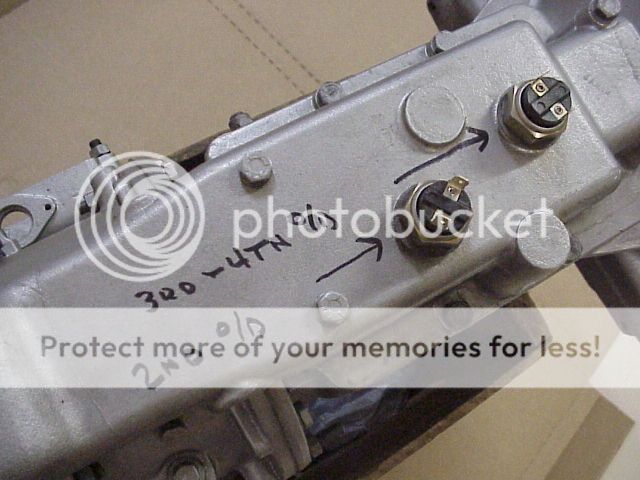
The od switches on the top of trans case should disengage as soon as out of 2,3 or 4th.I tested mine with engine off,listening to the solenoid.
Tom
 
For example, imagine the scenario: driving in 4th gear, OD engaged. Then come to a complete stop by pushing the clutch pedal and braking (without downshifting). Then engage reverse, without disengaging the OD manually by the lever. Will the OD disengage automatically before releasing the clutch?
Just to emphasize what Tom said, the OD will drop out as soon as you shift to neutral. So normally, there is no need to worry about not engaging the OD in reverse; it takes care of itself (through the action of the switches on top of the gearbox).

There is one exception that I've discovered: If you come to a stop at the top of a hill, with just the clutch depressed and the gearbox still in 4th (or 2nd or 3rd), then let the car roll backwards down the hill, the OD will lock up. But fortunately, just the weight of the car on the hill wasn't enough to damage it, so no harm done. It just surprised me, as I thought I had rolled into something (like the car that wasn't there behind me :smile: ).

And that's another point, it won't 'instantly' destroy the OD if you have reverse and OD selected at the same time. It takes considerable force to back the car up enough to damage the OD. Feels like you are trying to back over a curb or something. If you ever get that sensation, don't force it.

I often forget and leave the operating switch on (of course on a TR3 the switch is located where it's much harder to hit accidentally), even occasionally while backing out of the driveway. Hasn't hurt anything yet (in almost 40 years). So relax and be happy!
 
Tom, Randall, thank you.

If I understand correctly, the OD is only engaged when in 2, 3 or 4th gear. Even when shifting between gears, it will momentarily disengage.

Sounds like I will do a little learning once all is back together again. I like that it can be tested with the engine off - listening to the solenoid. Thanks for the feedback, again, my questions are perhaps a little naive, but I want to avoid wrecking a "new" OD due to operator error!
 
...If I understand correctly, the OD is only engaged when in 2, 3 or 4th gear. Even when shifting between gears, it will momentarily disengage.

Exactly. The engagement is limited by lockout switches on the top cover - you will want to be sure these are correctly adjusted (depth) to only provide a ground path when 2, 3 or 4 is selected.

ODTop_zps94c20774.jpg


I also added an indicator light to remind when OD was engaged (helpful for night driving).
 
Tom, Randall, thank you.

If I understand correctly, the OD is only engaged when in 2, 3 or 4th gear. Even when shifting between gears, it will momentarily disengage.

Sounds like I will do a little learning once all is back together again. I like that it can be tested with the engine off - listening to the solenoid. Thanks for the feedback, again, my questions are perhaps a little naive, but I want to avoid wrecking a "new" OD due to operator error!

The other way it can be engaged is to be stuck mechanically. My rebuilt trans and od came without the actuating lever adjusted or set.While setting it up I could not get the unit to engage.Car was up on jacks.I called the builder and he said the cone clutch on a new unit can stick engaged,and I would need to tap the casting ring in the od case while running ,od off ,to release the clutch.Now I realised my unit was always engaged,not failing to engage.
He said I would be able to hear it and I did.He said flip it off and a few times and it should be fine.I did and all is good.But If I had tried to back up,od electrically off,I could have damaged the unit.
Luckily I had read all the good info on this forum and didn't use reverse until everything checked out.
I am no od expert,so this all leads me to think the cone clutch must be engaged under pressure normally engine off.Engine starts,pressure builds clutch is held disengaged until od is switched on
So if you stall out while backing down a hill......?
Tom
 
I am no od expert,so this all leads me to think the cone clutch must be engaged under pressure normally engine off.Engine starts,pressure builds clutch is held disengaged until od is switched on
So if you stall out while backing down a hill......?
There are actually two friction clutches in the OD, one for direct drive and one for overdrive. A single sliding member carries both clutch facings, and moves to the rear under spring pressure for direct drive. To engage overdrive, the sliding member gets forced forward under hydraulic pressure. No pressure should mean no overdrive.

Another point, the hydraulic pump effectively runs from the driveshaft. The OD doesn't 'know' if the engine is running or not, only whether the car is moving and whether there is power to the solenoid. With the A-type, there is even a pressure accumulator so the OD will hold pressure for several minutes even with the car not moving.

A third roller (aka 'sprag') clutch covers the case where the sliding member is moving between positions (and if the direct drive clutch slips in 1st gear). It's located between the input and output and operates only on the relative motion of the two shafts. If the input tries to turn forward faster (or backwards slower) than the output, the sprag clutch locks them together. This is what causes the problem with reverse overdrive, the overdrive clutch tries to force the output to turn faster in the reverse (backward) direction, but the sprag clutch locks the two shafts together. Generally (so I'm told), if you put enough force on it, the sprag clutch loses and breaks, causing lots of expensive damage.

But with all the miles I've covered with overdrive, and all the ODs I've owned over the years (currently 3 installed in cars and probably enough parts to build 3 or 4 more), I've never seen one that was actually damaged that way. I don't doubt that it can happen, but it doesn't happen very often.
 
There are actually two friction clutches in the OD, one for direct drive and one for overdrive. A single sliding member carries both clutch facings, and moves to the rear under spring pressure for direct drive. To engage overdrive, the sliding member gets forced forward under hydraulic pressure. No pressure should mean no overdrive.

Another point, the hydraulic pump effectively runs from the driveshaft. The OD doesn't 'know' if the engine is running or not, only whether the car is moving and whether there is power to the solenoid. With the A-type, there is even a pressure accumulator so the OD will hold pressure for several minutes even with the car not moving.

A third roller (aka 'sprag') clutch covers the case where the sliding member is moving between positions (and if the direct drive clutch slips in 1st gear). It's located between the input and output and operates only on the relative motion of the two shafts. If the input tries to turn forward faster (or backwards slower) than the output, the sprag clutch locks them together. This is what causes the problem with reverse overdrive, the overdrive clutch tries to force the output to turn faster in the reverse (backward) direction, but the sprag clutch locks the two shafts together. Generally (so I'm told), if you put enough force on it, the sprag clutch loses and breaks, causing lots of expensive damage.

But with all the miles I've covered with overdrive, and all the ODs I've owned over the years (currently 3 installed in cars and probably enough parts to build 3 or 4 more), I've never seen one that was actually damaged that way. I don't doubt that it can happen, but it doesn't happen very often.

Thanks for the explanation Randall,
Tom
 
Back
Top