• Hey Guest!
    British Car Forum has been supporting enthusiasts for over 25 years by providing a great place to share our love for British cars. You can support our efforts by upgrading your membership for less than the dues of most car clubs. There are some perks with a member upgrade!

    **Upgrade Now**
    (PS: Upgraded members don't see this banner, nor will you see the Google ads that appear on the site.)
Tips
Tips

A question for the airplane guys...

TR6oldtimer

Darth Vader
Country flag
Offline
Where have the FAA numbers on airplanes gone? I seem to remember that once upon a time, the numbers on a plane were on the fuselage and under the wing and large enough to be read from 500 feet. The reason I ask you ask? Well where I live on the coast, the weekend pilots like to fly along it. While I am not opposed to their recreation, I do take exception to those who fly so low I can see their teeth, or those yo yo's who like to do aerobatics over residential areas. And then there was that clown who flew so low over the beach the people there felt compelled to hit the ground. Fortunately the pilot was identified and lost his license.

Without the numbers, it makes complaints to the FAA difficult.

Again, not ranting on pilots in general, just those few who seem not to care.
 
The Number are still on the side but they can be small enough that they are hard to read. With the way they can be register they could be register to another state even if you do not live thier and if the aircraft owner moves and does not report a change of address you still may not find who they are.

Don
 
I can't find the history on the old rules but they haven't been required on the wings for quite some time - since the 40s anyway... the old rules did away with the need for N-numbers on the wings, and allowed for 2" numbers on the fuselage. In the 80s the feds changed the rules again, requiring <span style="font-style: italic">new</span> aircraft and aircraft newer than a certain year (I think mid-60s but I can't remember) that are repainted to display 12" high numbers on the sides of the fuselage.

The UK still requires N-numbers on the wings.

As for the altitude issue - the <span style="font-style: italic">general</span> rule is 1000ft agl. Over congested areas its 1000ft above the highest obstacle within 2000ft of the aircraft.

Over <span style="font-style: italic">non congested areas</span> the rule is 500ft above the surface. However, over sparsely populated areas, water, etc, you can go down as low as you want as long as you're at least 500ft away from any person, vehicle (including boats), or structure.

SO... if they're flying down the coast <span style="font-style: italic">over the water</span> the argument can be made that it is legal to fly at 500ft or lower. In fact they sometimes require it in areas like New York City where ATC will routinely tell light aircraft to fly down the beach below 500ft to avoid JFK's airspace.
 
tr6oldtimer, the numbers commonly referred to as "n" numbers, "tail" or registration numbers goes something like this, aircraft less then 30 years old must be 12" , aircraft over 30 years old can be 2", these numbers can be placed on the tail, on the fuselage between the tail and rear end of wing, or on jet engine nacelles, i believe all experimental aircraft must use 12" numbers, all aircraft registered in the u.s. have numbers starting with an "n". i.e. N-2607
 
I would love to have airplanes perform aerobatics over my house or buzz me, but that's neither here nor there.

It's true that years ago registration marks were painted large on the wings and small on the vertical tail. Some time ago, I forget when, the FAA required the 12 inch marks on the sides of the fuselage and took away the requirement of the large marks on the wings. Aircraft 30 or more years old or aircraft resembling 30-year old aircraft may use the large wing/small tail marks.

There was a period '81 - '83 where the FAA allowed new aircraft to display small marks on the tail without the large wing marks. These aircraft are allowed to keep these marks until they are repainted.

I had a student who was enamored with buzzing. Once he buzzed some sunbathers on a beach, not knowing that the State Aviation Administrator was one of the sunbathers. He wrote his N-number in the sand. My student's ticket was suspended for thirty days for that.
 
aerog, these numbers work too, i knew a guy that flew his single engine plane under the white stone bridge and an alert kit riding with his parents over the bridge wrote down his tail number and reported it, needless to say the f.a.a pulled his license.
 
anthony7777 said:
i believe all experimental aircraft must use 12" numbers, all aircraft registered in the u.s. have numbers starting with an "n". i.e. N-2607

That's true - unless it is an older design aircraft (such as a Pietenpol Air Camper), then it can carry the NX-1234 number. I'm fairly sure it can get away with the 2" numbers too.

Edit: Actually the same 30-year rules apply to "experimental" aircraft...2" numbers can be used on designed 30+ years old. "Experimental" aircraft that has a maximum cruising speed of 180k or less can display 3" numbers, whether it be an old or new design.

I can't resist adding the requirement for 12" numbers on <span style="font-style: italic">any</span> aircraft (no matter the age) that crosses the ADIZ or DEWIZ. Those are the defense-identification zones that exist off our coasts in the continental USA (ADIZ) and Alaska (DEWIZ). If you want to fly your 1947 Cessna 140 from Florida to Nassau you have to stick 12" numbers on the airplane. People do that with 2" wide electrical tape all the time.
 
Update:

The requirement for wing-placed N numbers was deleted starting Jan 1 1961.
 
Twosheds said:
Aircraft 30 or more years old or aircraft resembling 30-year old aircraft may use the large wing/small tail marks.

Just to clarify, there is currently <span style="font-style: italic">no</span> requirement for N numbers on the wings - whether the aircraft is displaying small markings on the tail or not.
 
The guys that fly over water along the coast are no problem for me. In fact it is quite cool seeing the Coast Guard helicopters, or WWII fighters zooming along, or even the more mundane aircraft. It is just those who are flying over the city of Santa Cruz residential areas well below 1,000' that drive me nuts.

And then there was the State Department of Agriculture and their air spraying at night to eradicate the light brown moth infestation here. Twin engine aircraft criss-crossing the county at 500'. Sounded like a war zone. But I have to admit, that it was kind of cool in an irritating way. Sort of looking forward to the next application in June.

I also enjoy watching the C130s flying SAR exercises off the coast every quarter. Even at 1000' their roar is uplifting.

So I guess I should stop complaining as I am sure that my neighbors are equally irritated when I use my electric or air grinders.

Thanks for the input.
 
aerog said:
Twosheds said:
Aircraft 30 or more years old or aircraft resembling 30-year old aircraft may use the large wing/small tail marks.

Just to clarify, there is currently <span style="font-style: italic">no</span> requirement for N numbers on the wings - whether the aircraft is displaying small markings on the tail or not.


That's what <span style="font-style: italic">may</span> means.
 
tr6oldtimer, in the 80's myself and a fellow a.c. mechanic took care of 5 brand new citabrias for a guy that used them to tow banners at the jersey shore, as long as we took good care of them and and filled the fuel tanks hed let use fly them so yes id did some "buzzing" i once buzzed my moms house in sheepshead bay so low both she and my sister came out of the house and flipped me the bird, they didnt know it was me in the plane though that probably wouldnt have mattered, silly kid i was/am. v.f.r traffic over long island sound around westchester airport always gave me the frights.
 
TR6oldtimer said:
And then there was the State Department of Agriculture and their air spraying at night to eradicate the light brown moth infestation here. Twin engine aircraft criss-crossing the county at 500'. Sounded like a war zone. But I have to admit, that it was kind of cool in an irritating way. Sort of looking forward to the next application in June.

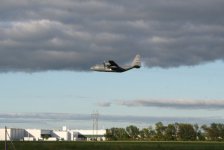
When the skitos get bad up here in the summer they start out spraying with cessna mixmaster then to a c130. They fly them over the city at about 250 feet which is quite a site.
 

Attachments

  • 10569.jpg
    10569.jpg
    43.9 KB · Views: 108
The SAR guys like our area, with a small boat harbor, they practice air/sea rescue. Neat to watch the loading ramp go down, then the parachute stuff, then the guys. The C130 then circles until the end of the exercise.

But a C130 at 250', that would be something. Never would happen here in zero tolerance Santa Cruz where they are suing the state over the moth eradication program.
 
anthony7777 said:
i once buzzed my moms house in sheepshead bay so low both she and my sister came out of the house and flipped me the bird,

Anthony, once when I was off work really sick (I was off 2 1/2 months) I was awakened from a nap by the sound of an airplane. My buddy had rented a Decathlon and buzzed the house. Then he put on an airshow for me. A great Get Well card, it made me feel better.

Much later I heard that my neighbor pulled up all his pot plants because of all the low-flying airplanes overhead!
 
anthony7777 said:
aerog, these numbers work too, i knew a guy that flew his single engine plane under the white stone bridge and an alert kit riding with his parents over the bridge wrote down his tail number and reported it, needless to say the f.a.a pulled his license.

My goodness, some people just have no sense of humor.
evilgrin0041.gif
We used to fly up the Hudson under the bridges in a Bell Jet Ranger. No one seems to bother a chopper though.
rolleye0012.gif
 
Back
Top