

• Hi Guest!
    If you appreciate British Car Forum and our 25 years of supporting British car enthusiasts with technical and anicdotal information, collected from our thousands of great members, please support us with a low-cost subscription. You can become a supporting member for less than the dues of most car clubs.

    There are some perks with a member upgrade!
    **Upgrade Now**
    (PS: Subscribers don't see this gawd-aweful banner
Tips
Tips

TR6 '74 Clutch Slave Cylinder location

TomChar

Senior Member
Country flag
Offline
It's not that I took it out so long ago I can't remember how it went, but that the PO was the one who had previously installed it, and he had the clutch disc in backwards, so ...

From the Moss Motors diagram, I think this is the correct way, but even with the new adjustable rod all the way in (not shown in this pic), there's still plenty of pre-load on the fork arm. It seems to operate the clutch, but I just want to make sure. I can locate the slave cylinder on the opposite side of the mounting plate, but that puts it almost two inches farther out, and with the adjustable rod extended all the way out, it just reaches the clutch fork arm.
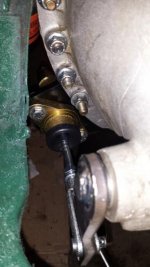
slave cylinder.jpg
 
Oh goodie, I don't have to take it apart again. Why are there three holes in the fork arm? Different applications I suppose?
 
The clevis on your adjustable arm looks awfully long to me. You may need to trim the pushrod to use the original slave mounting as Ken showed. Obviously, you want only the light pressure from the spring inside the slave to be removing the freeplay, there shouldn't be any real pre-load on the pushrod at all. Any force on that rod is taking away from the force holding the clutch engaged, so preload will very likely lead to a slipping clutch. Perhaps not right away, but eventually as the clutch wears a bit and the lever moves closer to the slave.

I'm not sure why there are 3 holes, AFAIK all Triumph applications use the center hole. But maybe the fellow that designed the arm didn't know that at the time.
 
Will do on trimming the pushrod. Maybe the three holes are to save weight?
 
Okay, I didn't need to trim the length, but simply add about 1/4" of thread to the shaft. While it was out, I pushed the clutch fork against the throwout bearing by hand, and measured the distance from the center hole to the engine plate - which for me was 5-3/4". I then went to see how far the spring pushes it out, and when I crawled back under the car, the piston was up against the rubber boot.

Clearly, the weight of the fluid, clutch pedal, and spring are all enough to maintain some, however slight, pressure on the piston, and thus the clutch fork. Now certainly there's a definite point on the fork when the throwout bearing contacts the clutch fingers, but it seems to me that the existing clutch system will always maintain some pressure on the throwout bearing. So I simply pushed the piston back in quite a ways (watching for spillage up top - I removed about 3/4 of the fluid from the reservoir first), and then let come to a "natural stop" when I released it - while watching that fluid level. I then adjusted my clevis to fit that distance.

Anyone see any issues with this method? I'll never be able to get any free play in this system. I now have plenty of adjustment space to back it off some more, and I haven't had a chance to test it as the car still needs a few other things before the first road test. Thanks
 
Yes, it is supposed to maintain some light force against the throwout bearing all the time. That way, it can automatically adjust as the clutch wears.

I'm not certain I understand how you arrived at the adjustment, but if you wound up with the piston fully bottomed in the slave cylinder, then you have defeated the automatic adjustment. It will work fine at first, but then as the clutch begins to wear, the piston cannot move deeper in the slave to compensate for the wear and will start holding the TOB harder against the pressure plate, meaning there is less force on the clutch plate. Eventually, the clutch will start to slip and the wear will become much more rapid. The higher steady pressure will also accelerate the wear of the thrust washer inside the engine (which can be a catastrophe if not detected and replaced in time).

But as long as there is room for the piston to move deeper in the slave, it should work fine.
 
Yes, it is supposed to maintain some light force against the throwout bearing all the time. That way, it can automatically adjust as the clutch wears.

I'm not certain I understand how you arrived at the adjustment, but if you wound up with the piston fully bottomed in the slave cylinder, then you have defeated the automatic adjustment. It will work fine at first, but then as the clutch begins to wear, the piston cannot move deeper in the slave to compensate for the wear and will start holding the TOB harder against the pressure plate, meaning there is less force on the clutch plate. Eventually, the clutch will start to slip and the wear will become much more rapid. The higher steady pressure will also accelerate the wear of the thrust washer inside the engine (which can be a catastrophe if not detected and replaced in time).

But as long as there is room for the piston to move deeper in the slave, it should work fine.

I think I'm good. The piston is closer to the top of the slave cylinder. I had to think about how the pressure plate works to figure out what you meant by automatic adjustment. My original concern was that the piston appeared to be to far out, and I would run out of travel before fully disengaging the clutch. Thanks for your help!
 
Back
Top