
-
 Hi Guest!
If you appreciate British Car Forum and our 25 years of supporting British car enthusiasts with technical and anicdotal information, collected from our thousands of great members, please support us with a low-cost subscription. You can become a supporting member for less than the dues of most car clubs.
There are some perks with a member upgrade!**Upgrade Now**
(PS: Subscribers don't see this gawd-aweful banner

Tips
- We have a special forum called "Member Articles" where you can submit actual articles for consideration for publication. Learn More
- Don't have an Avatar? If not, your avatar will default to the 1st character in your username. Go into "Account Details" to change your Avatar.
- Some basic forum navigation info: click
 Hey - did you know if you click on the title of a thread it will take you to the first unread post since you last visited that thread?
- Hey Guest - Is your British Car Club in our Clubs database? If not, send me a PM - Basil

- Looking for a local club? Click the "Clubs" tab above and browse hundreds of clubs world-wide.
- Add Android or iPhone APP: click
- Did you know - any picture or video you add in your posts in any marque-specific forum will also get added to the Media Gallery automatically.
- A few more tips about posting and replying: click
- Hey there Guest - be sure to keep your profile page up to date with interesting info about yourself: learn more
- More tips and tricks on Posting and Replying: click
 but were afraid to ask:
  STOP!! Never post your email address in open forums. Bots can "harvest" your email! If you must share your email use a Private Message or use the
  smilie in place of the real @
- Want to mention another member in a post & get their attention? WATCH THIS

- So, you created a "Group" here at BCF and would like to invite other members to join? Watch this!
- Hey Guest - A post a day keeps Basil from visiting you in the small hours and putting a bat up your nightdress!
- Hey Guest - do you know of an upcoming British car event?
 Pretty Please - add it to our Events forum(s) and add to the calendar! >> Here's How <<
- Hey Guest - you be stylin' Change the look and feel of the forum to fit your taste. Check it out
- If you run across an inappropriate post, for example a post that breaks our rules or looks like it might be spam, you can report the post to the moderators: Learn More
- If you would like to try some different "looks" or styles for the site, scroll to the very bottom, on the left and click the Style Selector.
You are using an out of date browser. It may not display this or other websites correctly.
You should upgrade or use an alternative browser.
You should upgrade or use an alternative browser.
TR6 71 TR6 Ignition Light Stays On
- Thread starter brent615
- Start date


amcboy
Jedi Hopeful
Offline
Just had this problem.
Traced it to the small connection on the ammeter.
A little ProGold and its happy again.
The light goes betweent he output of the Alternator and Battery.
So, if they are both at the same voltage there is no light.
If the Alternator fails, the battery is at 12V and the alternator at 0V. Light on.
Likewise if the battery dropped out of the car, the alternator would be at 12V, and the battery at 0V. Light on.
Try wiggling the small connector at the ammeter.
Then measure the voltage at the alternator to see if the thing is, ah, putting out.
Do you have the original 5 wire alternator or a 3 wire conversion?
If the 5 wire, then the loop wire (Brown with yellow) could be faulty.
Some places to start.
Traced it to the small connection on the ammeter.
A little ProGold and its happy again.
The light goes betweent he output of the Alternator and Battery.
So, if they are both at the same voltage there is no light.
If the Alternator fails, the battery is at 12V and the alternator at 0V. Light on.
Likewise if the battery dropped out of the car, the alternator would be at 12V, and the battery at 0V. Light on.
Try wiggling the small connector at the ammeter.
Then measure the voltage at the alternator to see if the thing is, ah, putting out.
Do you have the original 5 wire alternator or a 3 wire conversion?
If the 5 wire, then the loop wire (Brown with yellow) could be faulty.
Some places to start.

TR3driver
Great Pumpkin - R.I.P
Offline
Seems like your car must have been somewhat modified then. Normally, the light goes between the terminal on the alternator and the ignition circuit (white wire at ignition switch). That way, the light goes out when both the alternator and ignition are not powered. But the ammeter normally has power all the time (so things like the headlights and horns can work without having the ignition key on).amcboy said:Traced it to the small connection on the ammeter.
<snip>
The light goes betweent he output of the Alternator and Battery.

hondo402000
Darth Vader
Offline
you didnt put a MSD unit on did you? if so you got to install the diode or the light will stay on, I know, hours of checking wires until someone here made the comment and shazam it worked
amcboy
Jedi Hopeful
Offline
Randall, my car is stock and perhaps I was being too simplistic... Not knowing Brent615's skill level, I tried to simplify the concept.
However, in great expounded,difficult to understand, laborious, nearly complete detail:
The small brown and white wire from the ammeter connects to the ignition switch, where, when the ignition is in the "on" or "run" position, the white wires (igniton, and the aforementioned promlematic always on light) connect to the battery via the ammeter and starter terminal. So, say, if the ignition switch were on and the engine not running the connection would be made thus:
Negative terminal of battery to ground to alternator via engine block and black wire from same, then brown with yellow wire to lamp to white wire to ignition switch to brown with white wire to ammeter, through ammeter to brown wire to starter lug to positive terminal of battery.
The headlight switch is fed from the ignition switch terminal that has the brown and white wire on it above (via a brown and white wire) , so it always has voltage and that current travels through the ammeter when a load is applied. For example the headlights or running lights...
The horns, glove box lamp, interior lights,ignition key warning circuit, hazards, high beam lamp (in the speedometer) and trunk light (purple wires mostly) are all powered via the brown wire from the junction block (from the battery via the starter) through the fuse block and do not pass through the ammeter. Therefore none of these loads will cause the ammeter to move when activated.
The grounds or "common" for all of these items is to the frame/body/engine with the exception of the aforementioned problematic always on light.
So, theoretically, there could be a ground along the course of the brown and yellow wire from the alternator to the light. Its not likley to be on the white wire from the ignition switch to the light, because the ground would probably cause the engine not to run because the voltage to the points would be going directly to ground, rather than through the (resistance) load of the lamp. Electricity like water wanting to take the path of least resistance would likley choose the 1-2 Ohm coil over the (guessing here, but I can measure if necessary) 10 Ohm lamp.
So, while my earlier description was not entirely precise, its functionality was accurate to BASICALLY describe what's going on.
I will be happy to provide complete colored drawings if necessary.
/bcforum/images/%%GRAEMLIN_URL%%/cool.gif
However, in great expounded,difficult to understand, laborious, nearly complete detail:
The small brown and white wire from the ammeter connects to the ignition switch, where, when the ignition is in the "on" or "run" position, the white wires (igniton, and the aforementioned promlematic always on light) connect to the battery via the ammeter and starter terminal. So, say, if the ignition switch were on and the engine not running the connection would be made thus:
Negative terminal of battery to ground to alternator via engine block and black wire from same, then brown with yellow wire to lamp to white wire to ignition switch to brown with white wire to ammeter, through ammeter to brown wire to starter lug to positive terminal of battery.
The headlight switch is fed from the ignition switch terminal that has the brown and white wire on it above (via a brown and white wire) , so it always has voltage and that current travels through the ammeter when a load is applied. For example the headlights or running lights...
The horns, glove box lamp, interior lights,ignition key warning circuit, hazards, high beam lamp (in the speedometer) and trunk light (purple wires mostly) are all powered via the brown wire from the junction block (from the battery via the starter) through the fuse block and do not pass through the ammeter. Therefore none of these loads will cause the ammeter to move when activated.
The grounds or "common" for all of these items is to the frame/body/engine with the exception of the aforementioned problematic always on light.
So, theoretically, there could be a ground along the course of the brown and yellow wire from the alternator to the light. Its not likley to be on the white wire from the ignition switch to the light, because the ground would probably cause the engine not to run because the voltage to the points would be going directly to ground, rather than through the (resistance) load of the lamp. Electricity like water wanting to take the path of least resistance would likley choose the 1-2 Ohm coil over the (guessing here, but I can measure if necessary) 10 Ohm lamp.
So, while my earlier description was not entirely precise, its functionality was accurate to BASICALLY describe what's going on.
I will be happy to provide complete colored drawings if necessary.
/bcforum/images/%%GRAEMLIN_URL%%/cool.gif
over my head...you were right to keep it simple. wiring is far from my strong suit.
i did have a brown and yellow wire that was loosely hanging at the alternator a few months back (see pic). I must have connected back to the wrong point. I believe this is a Delco alternator. I can check later if needed.
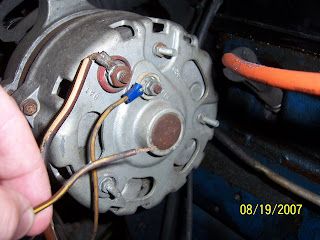
i did have a brown and yellow wire that was loosely hanging at the alternator a few months back (see pic). I must have connected back to the wrong point. I believe this is a Delco alternator. I can check later if needed.
T
Tinster
Guest
Guest
Offline
Brent'
I hope I'm not insulting you. Here is a wiring schematic
for a 1971 TR6. I keep my schematic in my car at all times
since I know squat about auto electronics but I'm good with
colors..
https://www.advanceautowire.com/tr2506.pdf
Again, I don't mean to insult you. I'm fairly brain dead
when it comes to auto wires and such. I make simple minded
testing devices to check out problems. I have several very
long #14 wires with alligator clips on both ends. When I
have doubts about a wire maybe having a grounding problem-
I unhook both ends of the suspect wire and connect my long
test wire to check it out. If the problem disappears with
my test wire hooked up; I replace the suspect wire.
Like I just did yesterday to my fuel gauge power wire!!
regards,
d
I hope I'm not insulting you. Here is a wiring schematic
for a 1971 TR6. I keep my schematic in my car at all times
since I know squat about auto electronics but I'm good with
colors..
https://www.advanceautowire.com/tr2506.pdf
Again, I don't mean to insult you. I'm fairly brain dead
when it comes to auto wires and such. I make simple minded
testing devices to check out problems. I have several very
long #14 wires with alligator clips on both ends. When I
have doubts about a wire maybe having a grounding problem-
I unhook both ends of the suspect wire and connect my long
test wire to check it out. If the problem disappears with
my test wire hooked up; I replace the suspect wire.
Like I just did yesterday to my fuel gauge power wire!!
regards,
d

TR3driver
Great Pumpkin - R.I.P
Offline
/bcforum/images/%%GRAEMLIN_URL%%/iagree.gif In fact, it's very similar if not identical to the alternator I used on my TR3A. Here's a shot of the voltage regulator mounted to the firewall. This is a later solid-state regulator, the one I originally used was much taller and had two relays inside.martx-5 said:That's an old Ford alternator. The voltage regulator is NOT incorporated inside the alternator. That means you have to have a seperate regulator somewhere, which also means that the charging circuit has been rewired.
I would suggest unplugging the regulator and see if the light stays out with the key on. If it does, replace the regulator.
PS the white stripe is not paint, but sunlight shining through the gap between the hood & body.
amcboy
Jedi Hopeful
Offline
/bcforum/images/%%GRAEMLIN_URL%%/iagree.gif I agree with Randall.
My wiring diatribe is now only applicable in principal.
Your loose wire is a bit of a pickle.
There is wee writing on the terminals of your alternator.
I can see it in your picture.
What do they say? Could maybe figure out where it goes.
My wiring diatribe is now only applicable in principal.
Your loose wire is a bit of a pickle.
There is wee writing on the terminals of your alternator.
I can see it in your picture.
What do they say? Could maybe figure out where it goes.
You guys are GREAT!...and no offense taken Tinster. I wouldn't be on here 3+ times a day if I knew more, but I have learned some things tonight.
Update: It is a Ford alternator as everyone said, there is a regulator mounted on the wheel well with 4 connectors only two of which have wires. 1 is a green wire from the fuse block to the regulator and the other is a yellow wire from the regulator terminal marked "F" to the alternator connector marked "FLO". The two unused connectors on the rgulator appear to be marked "A" and "S".
Open/unused connectors on the alternator are "STA", "GRD" and one with no label. The only thing my brown/yellow wire will reach is the STA. Tried that and light stays on still.
Regulator
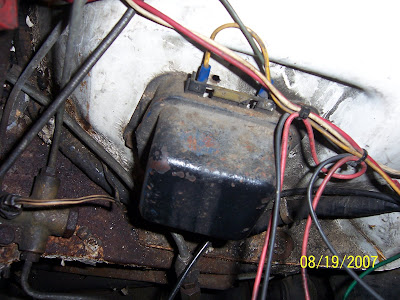
Update: It is a Ford alternator as everyone said, there is a regulator mounted on the wheel well with 4 connectors only two of which have wires. 1 is a green wire from the fuse block to the regulator and the other is a yellow wire from the regulator terminal marked "F" to the alternator connector marked "FLO". The two unused connectors on the rgulator appear to be marked "A" and "S".
Open/unused connectors on the alternator are "STA", "GRD" and one with no label. The only thing my brown/yellow wire will reach is the STA. Tried that and light stays on still.
Regulator
TR3driver
Great Pumpkin - R.I.P
Offline
Interesting. Art will correct me if I'm wrong, but I think that means your setup has been wired Chrysler-fashion, with the regulator not detecting when the alternator is turning but simply applying field current whenever the key is on (and the voltage is below the set point).
I think what you should have is the brown/yellow going to one of the terminals on the regulator, which I think should be marked "I". (This is likely the terminal that currently has a wire from the ignition on it.)
Then there should be a wire from the STA terminal on the alternator to the regulator (probably the 'S' terminal but I'm just guessing). This is a low-voltage AC output that tells the regulator when the alternator is turning. One of the relays runs on this AC voltage; and when the voltage is high enough, the relay closes and applies battery voltage to both the warning light terminal and the alternator field (through the other, voltage regulator relay).
Then the "A" terminal should go to somewhere close to the battery, as it both supplies power to the regulator (and alternator field) and serves as a voltage sense input.
But ... are you saying the light comes on even if the brown/yellow is not connected ? That implies there is something else connected to it somewhere.
I think what you should have is the brown/yellow going to one of the terminals on the regulator, which I think should be marked "I". (This is likely the terminal that currently has a wire from the ignition on it.)
Then there should be a wire from the STA terminal on the alternator to the regulator (probably the 'S' terminal but I'm just guessing). This is a low-voltage AC output that tells the regulator when the alternator is turning. One of the relays runs on this AC voltage; and when the voltage is high enough, the relay closes and applies battery voltage to both the warning light terminal and the alternator field (through the other, voltage regulator relay).
Then the "A" terminal should go to somewhere close to the battery, as it both supplies power to the regulator (and alternator field) and serves as a voltage sense input.
But ... are you saying the light comes on even if the brown/yellow is not connected ? That implies there is something else connected to it somewhere.
TR3driver
Great Pumpkin - R.I.P
Offline
Here's a diagram that might be helpful. Color codes are all wrong, of course, but it shows the connections between regulator & alternator. Also doesn't show your ammeter, but logically it would be in the lead marked "Large yellow/black" between the alternator and the junction block.

martx-5
Yoda

Offline
TR3driver said:But ... are you saying the light comes on even if the brown/yellow is not connected ? That implies there is something else connected to it somewhere.
/bcforum/images/%%GRAEMLIN_URL%%/iagree.gif The bn/yl wire comes right from the indicator light. That wire should be connected to the "I" terminal on the voltage regulator. If it's not connected to anything, it won't (shouldn't) light. That's how I read both the schematic that Tinster linked to, and the Ford diagram that Randall posted.