• Hey Guest!
    British Car Forum has been supporting enthusiasts for over 25 years by providing a great place to share our love for British cars. You can support our efforts by upgrading your membership for less than the dues of most car clubs. There are some perks with a member upgrade!

    **Upgrade Now**
    (PS: Upgraded members don't see this banner, nor will you see the Google ads that appear on the site.)
Tips
Tips

TR4/4A 67 TR4A hasn't run for 10 yrs+... suggestions?

moe_morin

Member
Country flag
Offline
I'm about ready to start her up after being stored for 10+ years. Fuel system and carbs are clean and ready. Brakes and master cyl have been rebuilt. Cooling system is clean.

I'm looking for help on what precautions should be taken on motor oil. Should I use an oil aditive? Detergent or non-detergent oil?

What about gas... everything in Wisconsin has 10% ethanol... is an aditive a good idea here? What type?

Also, what is recommended for coolant... straight antifreeze or a water mix? What brand is best?

The master cyl and wheel cyl's are new. I'm told to flush the entire system with denatured alcohol and blow it out with compressed air, then use a DOT 5 synthetic brake fluid. Any thoughts?

I would appreciate any comments or suggestions?

Thanks,
Moe Morin
 
My thoughts:

Definitely a good quality detergent oil, probably a 10W-40 or 20W-50.

Go with a premium grade fuel.

Straight antifreeze is not a very good coolant, so use a mix.

The choice of "regular" or silicone brake fluid is yours to make. There are reasonable arguments on both sides of that issue!
 
Andy is quite right about there being good arguments both ways, but I am a big fan of DOT 5. I converted my TR3A to DOT 5 silicone back around 1986 and never regretted it. I used to have to replace seals every few years; now it's been so long since I did a caliper that I've forgotten how. (Those same calipers are still working fine on my current TR3.)

But please note that "DOT 5" and "synthetic" are NOT the same thing! I have not seen any true DOT 5 that was labelled "synthetic", but most of the conventional (glycol) fluids are using that label now. "synthetic" doesn't really mean anything in this context anyway, all brake fluids are "synthetic" whether they say so or not.

Also, "DOT 5.1" is not silicone, not the same as "DOT 5" (which is always silicone).

Likewise, there is lots of room for debate on fuel additives. But after seeing what happened to several others' cars, I have started adding about 4 ounces of TC-W3 2-cycle oil to every tank on my TR3.

And after starting to have valve seat recession, I also add 1 oz of Redline lead substitute.
 
Guess you would already know to spin the engine up with the starter motor, with the plugs out and the coil disconnected, until you get some oil pressure. That way you know that the oil pump is working and that oil has been distributed through the engine before you subject it to the full force of combustion!

The 3 times that I have rebuilt TR engines, (3A twice, 4A once) I have run the engines up like this, then re-connected the plugs and started the engine. Run the engine for a short time to warm it up, then turn it off and dump the oil. Even with an engine that has been tanked and blown out with compressed air, you will be surprised how much junk comes out, and oil is cheap compared to bearings.

Hope this helps

Rocky
 
Further to what Rocky said about spinning the engine up to get oil pressure. I do that every spring after six months of storage. BUT for right after I rebuilt my engine I used a large electric drill and a home made aluminium fixture to spin the oil pump directly without having to move the engine parts. I just removed the distributor and put the long aluminium rod that I had filed to match the bottom of the distribuor down the hole and spun it up with the drill unitl I got oil pressure. Then I put the dizzy back on, set the timing and away she went.
 
moe_morin said:
Can you expand on why you use TWC3 2-cycle oil in the gas?
At this point I consider it experimental; I don't have what I consider proof that it is either necessary or beneficial. But a few years back I started hearing stories of severe, otherwise unexplained piston ring wear that at least might be explained by the gasohol washing away the oil film at cold starts. For example, one of our local club members had his TR4 engine rebuilt and, although it ran fine at first, less than 10,000 miles later it was down on power and blowing blue smoke. The thought was that it had broken a ring or something, but on tear-down the rings looked fine, they were just worn out! End gaps over .030". Could be bad parts or whatever, but I've heard similar stories of other old engines (like Land Rover & Ford flatheads).

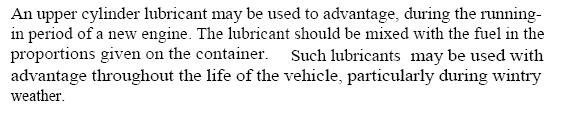
Plus the TR3 owner's manual suggests the use of an upper cylinder lubricant.

Then I did some poking around and found several opinions that TC-W3 2-cycle oil was a cheap and effective alternative to Marvel Mystery Oil, Seafoam, and other such upper cylinder lubricants. For example: https://www.bobistheoilguy.com/forums/ubbthreads.php?ubb=showflat&Number=2199335#Post2199335

Likely it is wishful thinking (placebo effect), but after a the first few tankfuls my idle rpm started creeping up and when I turned it back down again, it seemed like the engine would idle slower than before without dying. (I run a light alloy flywheel, which doesn't idle as well as stock.) I also seem to be getting slightly better gas mileage, typically around 24 mpg (indicated) in daily driving, where it was around 22-23 before using the oil. Again, I can't prove that it was caused by adding the oil, I've made several other changes along the way (like adding a carb heat shield), or even that the changes are real. But at least for the moment, I'm encouraged enough to continue the experiment.

BTW, TC-W3 is a performance specification for 2-cycle oil (kind of like GL4 for gear oil). Although the consensus is that any TC-W3 rated oil will give the same performance, I opted to use "Quicksilver" brand as I tend to trust them more than Pennzoil or the Wally-mart house brand. 4 oz/tank is also slightly more than the recommended 1:500 ratio; I should probably taper back to 3 oz/tank.

I use old vitamin pill bottles to divide up the doses ahead of time, so at the pump I just dump in a bottle and fill it up.
 

Attachments

  • 29469.jpg
    29469.jpg
    20.2 KB · Views: 276
I agree with Randall on the Silicone brake fluid. I have been using it in my TR4A since the 80's as well, with no problems.
I don't see any reason to run premium gasoline though. It really depends on how the car is tuned, doesn't it? There are always lots of opinions on additives and unfortunately you can't really know if they are beneficial until you tear it down, but on the other hand what can it hurt?

Dan B
 
DanB said:
I don't see any reason to run premium gasoline though. It really depends on how the car is tuned, doesn't it?
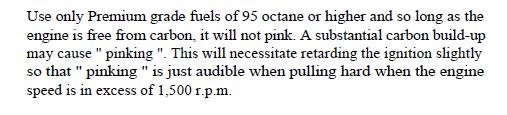
What do the original manuals say for the TR4 engine? The "small car" engines were supposed to get a premium grade, and my current '67 Sports 1200 seems to balk at anything less than today's 93 octane (runs ok but does "diesel" at shutoff)!
 
I don't have a 4A manual handy to check, but the 3A owner's manual says 95 octane. Likely that is research octane, while the ratings on the pump in the US are the average of the research and (lower) motor octane numbers.
 

Attachments

  • 29474.jpg
    29474.jpg
    18.2 KB · Views: 200
Back
Top