

-
 Hey Guest!
British Car Forum has been supporting enthusiasts for over 25 years by providing a great place to share our love for British cars. You can support our efforts by upgrading your membership for less than the dues of most car clubs. There are some perks with a member upgrade!**Upgrade Now**
(PS: Upgraded members don't see this banner, nor will you see the Google ads that appear on the site.)
You are using an out of date browser. It may not display this or other websites correctly.
You should upgrade or use an alternative browser.
You should upgrade or use an alternative browser.
TR4/4A 3A and 4A distributors?
- Thread starter karls59tr
- Start date




TR3driver
Great Pumpkin - R.I.P
Offline
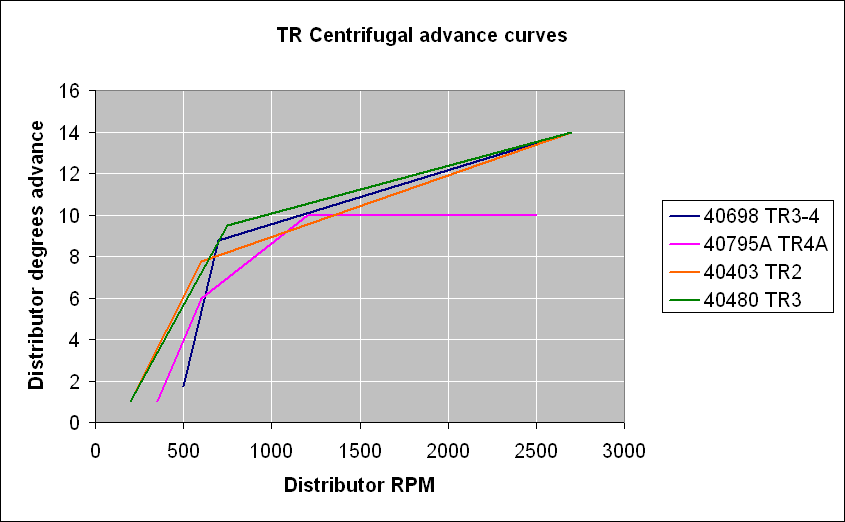
Yeah, but that's your post, not mine.google tr4 advance curve and guess what is the first image that comes up?
Not that I'm complaining, I'm glad it's useful. Makes it a lot easier to visualize the curves than just reading the numbers in a table.

Paulus
Senior Member
Offline
We were discussing the total amount of advance and how it hits max at a fairly low rpm. The previous chart shows that the TR2/3and 4 curves have more advance over a longer range. Why is that and what would be the positives and negatives of having more advance in a 4A.
TR3driver
Great Pumpkin - R.I.P
Offline
I don't know.
Optimum ignition timing is one of those things that borders on black magic. It's affected by all sorts of things, including combustion chamber shape, exhaust and intake, camshaft and so on (all of which changed at least once during TR2-4A production).
I've been told that, even after all these years, engine makers still run a new engine design on the dyno to find the "sweet spot" for timing and then work from there to allow for changes in fuel quality, air temperature and so on. Here's a write-up that goes over a few of the concepts (although it's written from the standpoint of needing less timing when adding supercharging, duh). https://www.innovatemotorsports.com/resources/myths.php
Adding more timing may get you more power/economy, or less, or result in disaster.

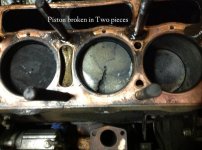
That damage was caused by a failed valve stem seal (combined with badly worn guides), but the effect would be the same if you get preignition (aka knock) from too much timing. Since it only happened at higher speeds, I had no idea anything was wrong until the piston broke (laying a cloud of blue smoke behind me on the freeway).
Optimum ignition timing is one of those things that borders on black magic. It's affected by all sorts of things, including combustion chamber shape, exhaust and intake, camshaft and so on (all of which changed at least once during TR2-4A production).
I've been told that, even after all these years, engine makers still run a new engine design on the dyno to find the "sweet spot" for timing and then work from there to allow for changes in fuel quality, air temperature and so on. Here's a write-up that goes over a few of the concepts (although it's written from the standpoint of needing less timing when adding supercharging, duh). https://www.innovatemotorsports.com/resources/myths.php
Adding more timing may get you more power/economy, or less, or result in disaster.
That damage was caused by a failed valve stem seal (combined with badly worn guides), but the effect would be the same if you get preignition (aka knock) from too much timing. Since it only happened at higher speeds, I had no idea anything was wrong until the piston broke (laying a cloud of blue smoke behind me on the freeway).

Marvin Gruber
Yoda
Offline
Bottom line, if you had choice of distriubutors which one would be best for normal driving
marv
marv

Rut
Obi Wan
Offline
I'm a real novice when it comes to distributers and the best decision I've ever made is to send mine to advanced Distributers for a rebuild to my engines specs...night and day.
Rut
https://www.advanceddistributors.com
Rut
https://www.advanceddistributors.com
TR3driver
Great Pumpkin - R.I.P
Offline
My opinion, stick with the stock setup unless you have the time, inclination and tools to validate any changes. The factory was certainly conservative in their choices, but at the same time interested in the best performance they could deliver consistent with long engine life under a wide variety of conditions. You could probably squeeze out a few percent more power and/or fuel economy; but is that really worth risking the kind of damage shown above? If you are going racing, then the answer is certainly "Yes", but not (I think) for normal driving.
In other words, even though I don't know the specific whys and wherefores, I'm certain they had valid reasons for making the timing curve more conservative when they put so much time and energy into making the engine more useful on the street (by optimizing mid-range power rather than peak power). It wasn't just laziness or stupidity.
In other words, even though I don't know the specific whys and wherefores, I'm certain they had valid reasons for making the timing curve more conservative when they put so much time and energy into making the engine more useful on the street (by optimizing mid-range power rather than peak power). It wasn't just laziness or stupidity.
Paulus
Senior Member
Offline
Ok, I have learned something. I also suffered a broken piston fortunately mine held together by the pin and I was able to make the 200 mile drive home. Albeit with limited power. Good thing was that by pulling the engine it helped make the decision to do a resto. Finished it last summer after 18 mo.
Marvin Gruber
Yoda
Offline
I had a couple of 4 cyl distributors apart last week. While cleaning up I did notice one was stamped 10 degrees and the other 16 degrees. Only differences I could see was the lenght of the little arm where the stamping was done. I thought then a person could probably modify advancement on the 10 degree distributor and what effect that would do so this thread was timely for me.
Marv
Marv
TR3driver
Great Pumpkin - R.I.P
Offline
The only other differences in the centrifugal advance are the spring rate and length of the advance springs, which are difficult to see with the naked eye. There's a good article at https://www.starchak.ca/tech/pdfs/lucastuning.pdf
which talks about the various relationships.
FWIW, Marcel has also posted a good article on converting a later "electronic" distributor as a replacement for the Lucas. Not written for Triumphs, but the same mods should work for the TR2-4 motor.
https://www.starchak.ca/tech/pdfs/hitachi.pdf
which talks about the various relationships.
FWIW, Marcel has also posted a good article on converting a later "electronic" distributor as a replacement for the Lucas. Not written for Triumphs, but the same mods should work for the TR2-4 motor.
https://www.starchak.ca/tech/pdfs/hitachi.pdf