• Hey Guest!
    British Car Forum has been supporting enthusiasts for over 25 years by providing a great place to share our love for British cars. You can support our efforts by upgrading your membership for less than the dues of most car clubs. There are some perks with a member upgrade!

    **Upgrade Now**
    (PS: Upgraded members don't see this banner, nor will you see the Google ads that appear on the site.)
Tips
Tips

Any B-25 fans?

NutmegCT

Great Pumpkin
Bronze
Offline
A few short videos taken during the DAV's B-25 day at Bradley International Airport last weekend.

The decibel level inside the aircraft seems to match the airspeed; must be those two Wright 2600 radials. I asked the pilot how the heck guys flying those things during WW2 could hear anything even with headsets. He said "most of them were deaf after the first full day". And headsets back then were nothing like the noise-cancelling devices we use now.

Enjoy.


https://youtu.be/iAX7FLw0QIY

https://youtu.be/QBLdv4bO3qY

https://youtu.be/3KPFdk84ick

https://youtu.be/OfgsE03TYUs

https://youtu.be/iP4pxNb2IeU

https://youtu.be/CUf0I_xMwiM
 
Very cool... it looks like in the second link (O3qy) they shut down one engine.
 
Billy Mitchell, right? As a kid back in the early 60's I remember building a plastic model of the B25.
 
I built one too. Remember thinking how neat they were. Still think they're great looking.
 
the "Mitchell" bomber. in honor of Gen. Billy Mitchell, a long-time (and controversial) advocate of military aviation.

James Doolittle led the famous "Tokyo Raid" in early 1942, in retribution for the Pearl Harbor attack. Imagine 16 B-25s jammed onto the flight deck of a late 1930s aircraft carrier. There were originally more than 16 - but that's another story! Mitchell bombers had never been intended for use on carriers. Doolittle did the first takeoff. If the first plane, heavily loaded with bombs and fuel to reach Japan and then China, could make it safely off the ship and into the air, the following planes - and crews - had increasingly better chances (longer takeoff space) to do the same. The 1944 film "Thirty Seconds over Tokyo" told the story of the raid; which greatly boosted USA morale early on.


Tom
 
That would be really cool to watch...IF
IF I COULD
 
A final toast for the Doolittle Raiders - it's the cup of brandy that no one wants to drink.

On Tuesday, in Fort Walton Beach, Florida, the surviving Doolittle Raiders gathered publicly for the last time.

They once were among the most uni...versally admired and revered men in the United States. There were 80 of the Raiders in April 1942, when they carried out one of the most courageous and heart-stirring military operations in this nation's history. The mere mention of their unit's name, in those years, would bring tears to the eyes of grateful Americans.

Now only four survive.

After Japan's sneak attack on Pearl Harbor, with the United States reeling and wounded, something dramatic was needed to turn the war effort around.

Even though there were no friendly airfields close enough to Japan for the United States to launch a retaliation, a daring plan was devised. Sixteen B-25s were modified so that they could take off from the deck of an aircraft carrier. This had never before been tried -- sending such big, heavy bombers from a carrier.

The 16 five-man crews, under the command of Lt. Col. James Doolittle, who himself flew the lead plane off the USS Hornet, knew that they would not be able to return to the carrier. They would have to hit Japan and then hope to make it to China for a safe landing.

But on the day of the raid, the Japanese military caught wind of the plan. The Raiders were told that they would have to take off from much farther out in the Pacific Ocean than they had counted on. They were told that because of this they would not have enough fuel to make it to safety.

And those men went anyway.

They bombed Tokyo, and then flew as far as they could. Four planes crash-landed; 11 more crews bailed out, and three of the Raiders died. Eight more were captured; three were executed. Another died of starvation in a Japanese prison camp. One crew made it to Russia.

The Doolittle Raid sent a message from the United States to its enemies, and
to the rest of the world: We will fight. And, no matter what it takes, we
will win.

Of the 80 Raiders, 62 survived the war. They were celebrated as national heroes, models of bravery. Metro-Goldwyn-Mayer produced a motion picture based on the raid; "Thirty Seconds Over Tokyo," starring Spencer Tracy and Van Johnson, was a patriotic and emotional box-office hit, and the phrase became part of the national lexicon. In the movie-theater previews for the
film, MGM proclaimed that it was presenting the story "with supreme pride."

Beginning in 1946, the surviving Raiders have held a reunion each April, to commemorate the mission. The reunion is in a different city each year. In 1959, the city of Tucson, Arizona, as a gesture of respect and gratitude, presented the Doolittle Raiders with a set of 80 silver goblets. Each goblet was engraved with the name of a Raider.

Every year, a wooden display case bearing all 80 goblets is transported to the reunion city. Each time a Raider passes away, his goblet is turned upside down in the case at the next reunion, as his old friends bear solemn witness.

Also in the wooden case is a bottle of 1896 Hennessy Very Special cognac. The year is not happenstance: 1896 was when Jimmy Doolittle was born.

There has always been a plan: When there are only two surviving Raiders, they would open the bottle, at last drink from it, and toast their comrades
who preceded them in death.

As 2013 began, there were five living Raiders; then, in February, Tom Griffin passed away at age 96.

What a man he was. After bailing out of his plane over a mountainous Chinese forest after the Tokyo raid, he became ill with malaria, and almost died. When he recovered, he was sent to Europe to fly more combat missions. He was shot down, captured, and spent 22 months in a German prisoner of war camp.

The selflessness of these men, the sheer guts ... there was a passage in the Cincinnati Enquirer obituary for Mr. Griffin that, on the surface, had nothing to do with the war, but that emblematizes the depth of his sense of duty and devotion: "When his wife became ill and needed to go into a nursing home, he visited her every day. He walked from his house to the nursing home, fed his wife and at the end of the day brought home her clothes. At night, he washed and ironed her clothes. Then he walked them up to her room the next morning. He did that for three years until her death in 2005."

So now, out of the original 80, only four Raiders remain: Dick Cole (Doolittle's co-pilot on the Tokyo raid), Robert Hite, Edward Saylor and David Thatcher. All are in their 90s. They have decided that there are too few of them for the public reunions to continue.

The events in Fort Walton Beach this week will mark the end. It has come full circle; Florida's nearby Eglin Field was where the Raiders trained in secrecy for the Tokyo mission. The town is planning to do all it can to honor the men: a six-day celebration of their valor, including luncheons, a dinner and a parade.

Do the men ever wonder if those of us for whom they helped save the country have tended to it in a way that is worthy of their sacrifice? They don't talk about that, at least not around other
people. But if you find yourself near Fort Walton Beach this week, and if you should encounter any of the Raiders, you might want to offer them a word of thanks. I can tell you from firsthand observation that they appreciate hearing that they are remembered.

The men have decided that after this final public reunion they will wait until a later date -- some time this year -- to get together once more, informally and in absolute privacy. That is when they will open the bottle of brandy. The years are flowing by too swiftly now; they are not going to wait until there are only two of them.

They will fill the four remaining upturned goblets. And raise them in a toast to those who are gone.

 
Wow...speechless.
What a generation.
 
Today's younger generation is so clueless. To bad as that sets up the potential to forget our past and it's mistakes.
 
My parents (and their whole generation) put their lives on hold to win a two front war. We grew up on stories of Doolittle's missions, the Cactus Air Force, Claire Chennault and the Flying Tigers. And some personal stories as well. They all deserve our respect and admiration.

I don't lump all of the current younger generation into the "clueless" category, I know too many of them who have stood up, taken the oath and performed with honor and pride. I even have nephews and nieces who are firefighters, police and military. These kids are our future, I laud them.
 
:iagree:

Yep. Ft. Campbell and the 101st, Special Forces, etc., etc. are in our backyard here. There are several families who are members of the church I serve. Fantastic young folks; in many ways much more committed and focused than we were!
 
Another +1 for younger folks. Yesterday I went to Advance Auto. The guy who helped me test my charging system and battery, is about 30, and spent 7 years in the US Marine Corps. We must have talked for 30 minutes about "things". His supervisor kept wondering why it took so long to change my battery.

He was one of the most upstanding, knowledgeable, and honorable young men I've met.

Semper fidelis.
Tom
 
You're right Doc. At least some of the younger group are responsible. I have one nephew who will soon retire as a firefighter and another who is an Army Major and a grandson who is leaving soon for his second tour in Afghanistan.
 
After the war David Thatcher became a mailman in Missoula, Montana, he delivered to my wifes parents home. Most people did not know who their mailman was, mom in law did.
 
You're right Doc. At least some of the younger group are responsible.

[h=1]“Our youth now love luxury. They have bad manners, contempt for authority; they show disrespect for their elders and love chatter in place of exercise; they no longer rise when elders enter the room; they contradict their parents, chatter before company; gobble up their food and tyrannize their teachers.” (Socrates)[/h]
I have to believe more than some. I am sure that there were many in the 1920's and 1930's lamenting the state of "today's youth." For the most part, they are smart, respectful, thoughtful, and, I believe, would step up to the plate if and when necessary. At the same time they have witnessed Watergate, financial collapses and other governmental & private sector er indiscretions. They are not naive. I am getting to be a curmudgeon and spend more than my share of time b*tching about the next generation - then I remember, we raised them!

:laugh:
 
It's been said before: "'Twas ever thus."
 
Like all generations you can find both ends of the spectrum and every point in between, from the Paris Hiltons to the young soldiers and marines who died or were horribly wounded to safeguard our right to complain about their generation. I try to remember never to paint them all with the same brush.
 
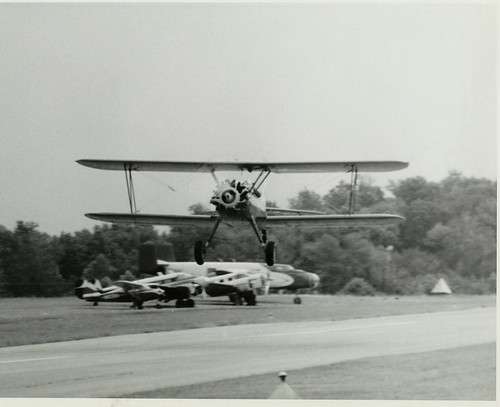
In the rear of this shot of me and my old Stearman, is the 25 we used to fly about once a month just to keep her in tune and make sure she was running right. They are pretty gentle to fly with good performance. I loved to fly it, but it was very noisy due to the fact that the propeller tips were only a couple feet behind your ears. That's the only fault we ever found with the aircraft. PJ

 
the "Mitchell" bomber. in honor of Gen. Billy Mitchell, a long-time (and controversial) advocate of military aviation.

James Doolittle led the famous "Tokyo Raid" in early 1942, in retribution for the Pearl Harbor attack. Imagine 16 B-25s jammed onto the flight deck of a late 1930s aircraft carrier. There were originally more than 16 - but that's another story! Mitchell bombers had never been intended for use on carriers. Doolittle did the first takeoff. If the first plane, heavily loaded with bombs and fuel to reach Japan and then China, could make it safely off the ship and into the air, the following planes - and crews - had increasingly better chances (longer takeoff space) to do the same. The 1944 film "Thirty Seconds over Tokyo" told the story of the raid; which greatly boosted USA morale early on.


Tom
Takeoff space was the same for all aircraft leaving the deck of the carrier due to the closeness of the wingtips to the carriers island. If they had more runway length they stood a chance of veering towards the island and their wingtips hitting it.
 
Back
Top